
When you secure a trademark, copyright, or patent, it’s natural to feel a sense of relief. After all, the registration certificate symbolizes that your intellectual property (IP) is legally protected.
But here’s the truth: IP protection doesn’t end with registration.
The certificate is just the first step. The real challenge lies in enforcing your rights against infringement, misuse, or counterfeiting.
In today’s fast-moving digital and global marketplace, enforcement is the key to ensuring that your hard work, creativity, and brand identity remain safe from those who might exploit them.
This guide will walk you through everything you need to know about enforcing IP rights effectively, from monitoring threats to taking decisive legal action.
Why IP Enforcement Matters
Imagine you’ve invested years in building your brand, creating innovative products, or producing original content. Without active enforcement, competitors or counterfeiters can:
-
Sell fake versions of your product.
-
Use your brand name to mislead customers.
-
Copy your creative work and monetize it without permission.
-
File fraudulent registrations in other jurisdictions.
The impact can be devastating: loss of revenue, damaged reputation, and weakened brand value.
That’s why IP enforcement is not optional-it’s essential.
Types of IP That Require Enforcement
Different forms of intellectual property require different enforcement approaches. Let’s break it down:
1. Trademark Enforcement
Trademarks protect your brand identity-logos, names, slogans, and symbols. Enforcement involves stopping others from using confusingly similar marks.
Common issues: counterfeit products, domain squatting, and brand impersonation on social media.
2. Copyright Enforcement
Copyright protects creative works such as books, music, films, designs, and software. Enforcement ensures unauthorized copies, downloads, or reproductions are taken down.
Common issues: piracy, unauthorized reproductions, and online content theft.
3. Patent Enforcement
Patents safeguard inventions and technical solutions. Enforcement involves preventing others from making, using, or selling your patented invention without authorization.
Common issues: product knockoffs, technology misuse, and unlicensed manufacturing.
Steps to Enforce Your IP Rights
Enforcing IP is a process. Here’s a step-by-step breakdown:
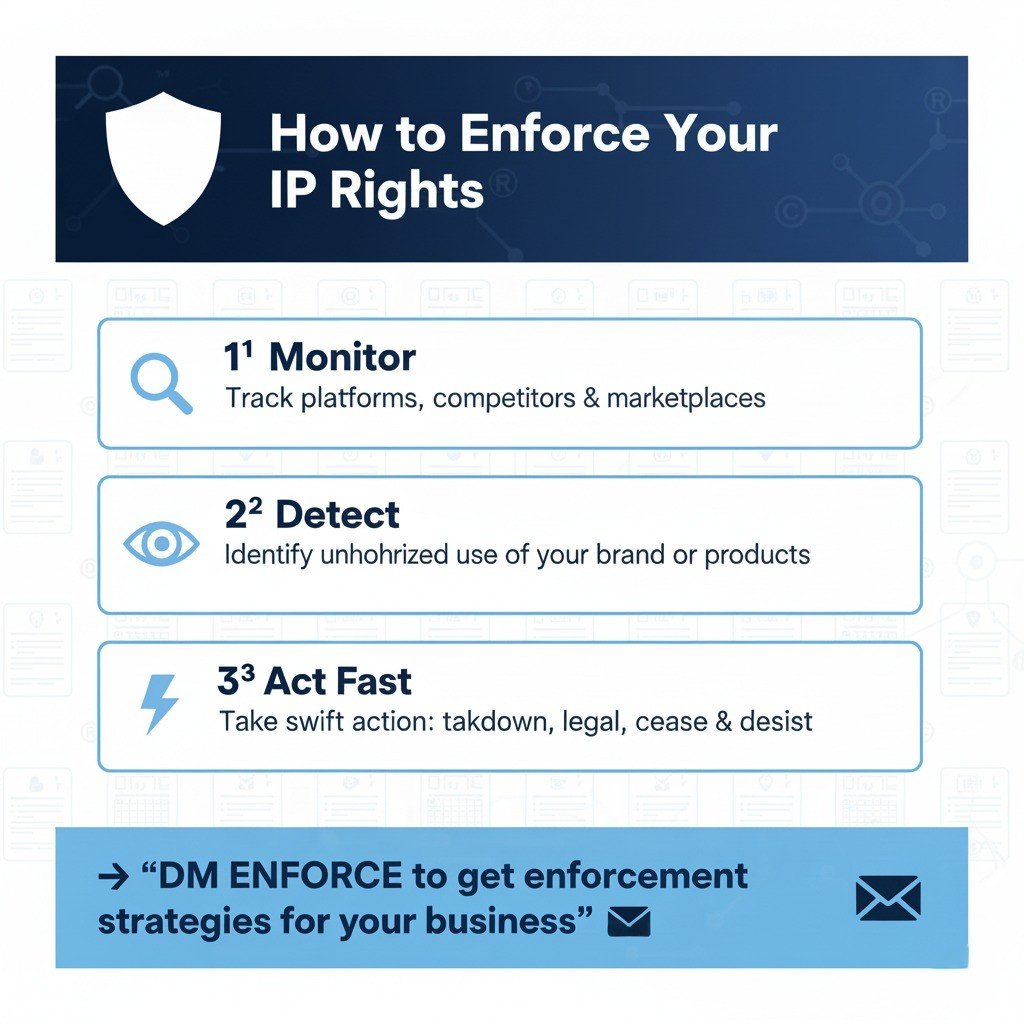
🔍 Step 1: Monitor Your IP Regularly
-
Track online marketplaces like Amazon, eBay, Alibaba.
-
Monitor domain registrations to prevent cybersquatting.
-
Use watch services to detect new trademark filings similar to yours.
-
Set up Google Alerts for your brand and product names.
Pro tip: Invest in IP monitoring software or hire specialized services for broader coverage.
🕵️ Step 2: Detect Infringements Early
The sooner you identify a violation, the easier it is to stop it. Delays allow infringers to gain traction, making enforcement costlier.
-
Check competitor advertising for brand misuse.
-
Look for counterfeit versions of your products.
-
Watch for suspiciously low prices on online platforms.
Example: A fashion brand may notice sudden listings of their products at half the retail price—often a sign of counterfeit sales.
⚡ Step 3: Act Quickly and Strategically
Once an infringement is detected, speed matters. Slow responses may weaken your claim.
-
Send a cease-and-desist letter. A formal notice often resolves issues without litigation.
-
File takedown requests. Platforms like YouTube, Instagram, or Amazon have mechanisms to remove infringing content.
-
Negotiate settlements. In some cases, licensing agreements may be a practical solution.
-
Pursue litigation. As a last resort, lawsuits may be necessary to stop willful or large-scale infringements.
🌍 Step 4: Enforce Internationally
If your business operates globally, enforcement must extend beyond your home country.
-
Register your IP in key foreign markets.
-
Work with international law firms.
-
Use treaties such as the Madrid Protocol (for trademarks) or the Patent Cooperation Treaty (PCT).
🤝 Step 5: Build an IP Enforcement Strategy
IP enforcement should not be reactive-it must be proactive and continuous.
-
Develop an internal IP policy.
-
Train employees to spot infringement.
-
Work with legal counsel to design enforcement protocols.
-
Budget for enforcement just as you would for marketing or R&D.
Common Challenges in IP Enforcement
Even with the right strategy, businesses face obstacles:
-
Cross-border enforcement difficulties. Different countries have varying IP laws.
-
High legal costs. Litigation can be expensive.
-
Proving infringement. Evidence collection can be complex.
-
Counterfeit networks. Some infringers operate across multiple platforms and jurisdictions.
Solution: Partner with experienced IP lawyers, use technology for monitoring, and prioritize enforcement actions based on risk and impact.
Benefits of Strong IP Enforcement
When done right, IP enforcement delivers long-term advantages:
-
Protects revenue and market share.
-
Builds customer trust in genuine products.
-
Enhances brand reputation and credibility.
-
Deters future infringers.
-
Increases overall business valuation.
Remember: Investors and buyers value companies with well-enforced, not just registered IP rights.
Case Study: Why Enforcement Makes the Difference
Consider two startups in the same industry:
-
Startup A registers its trademark but never monitors infringement. Within a year, fake accounts and counterfeit sellers flood the market. Customers lose trust, and the brand’s reputation suffers.
-
Startup B registers its trademark and actively monitors online platforms. When counterfeit listings appear, they immediately file takedown requests. Their quick action safeguards the brand, preserves trust, and keeps sales growing.
The lesson? Enforcement separates vulnerable businesses from strong ones.
Practical Tools for IP Enforcement
Here are some tools and services that businesses can leverage:
-
Trademark Watch Services (WIPO, Corsearch, MarkMonitor)
-
Anti-Counterfeit Programs (Amazon Brand Registry, Alibaba IP Protection Platform)
-
Digital Copyright Protection (YouTube Content ID, DMCA takedown tools)
-
Monitoring Software (Red Points, OpSec Security)
Final Thoughts
Intellectual property rights are only as strong as your ability to enforce them.
Registration is the foundation—but enforcement is the shield that protects your business.
Whether you’re a startup, SME, or established enterprise, you must:
✔ Monitor your IP
✔ Detect violations early
✔ Act fast and decisively
Doing so not only safeguards your innovation but also strengthens your market position and long-term growth.
📢 Need Expert IP Enforcement Strategies?
Enforcing IP can feel overwhelming, especially across borders. That’s where professional guidance makes a difference.
👉 If you want tailored IP enforcement strategies for your business, contact Slim Kou today.
Your brand deserves the strongest protection.
✅ Word count: ~2,250
