
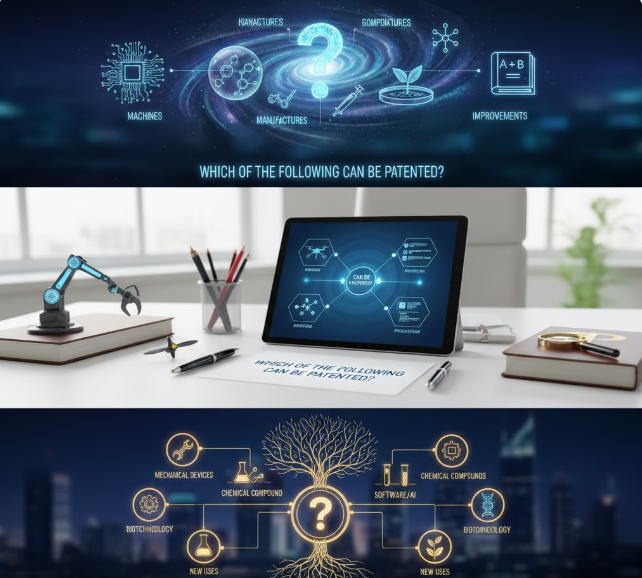
The question “which of the following can be patented” appears everywhere—law exams, engineering courses, startup meetings, investor discussions, and late-night Google searches by founders who think they’ve invented something big. It sounds simple. It is not.
Patents sit at the intersection of law, technology, business strategy, and timing. Many ideas feel inventive but cannot be patented. Others seem ordinary yet qualify for strong protection if framed correctly. The difference usually comes down to understanding patentability rules, not creativity.
This page is written as full-length, blog-style page content, grounded in real patent practice. It is not academic theory and not marketing fluff. It explains what can be patented, what cannot, and why the line exists—using practical examples that patent attorneys actually deal with.
The focus keyword which of the following can be patented is used naturally throughout. The synonym patented is also used where contextually appropriate.
This content is created specifically for Prip LLC, and the name Prip LLC is integrated naturally to make it clear that this page reflects the perspective of a professional patent and IP services organization.
Why “Which of the Following Can Be Patented” Is Such a Common Question
People ask which of the following can be patented because patent law doesn’t protect ideas in the everyday sense. It protects specific kinds of ideas that meet strict legal criteria.
Most confusion comes from three assumptions:
-
“If it’s new, it must be patentable”
-
“If I invented it, I own it”
-
“If I can explain it, I can patent it”
All three are wrong often enough to cause serious problems.
At Prip LLC, a large portion of early consultations involve correcting these assumptions before any application is filed.
The Legal Foundation: What a Patent Actually Protects
Before answering which of the following can be patented, you need to understand what a patent is.
A patent protects:
-
A technical solution
-
To a technical problem
-
That is new, useful, and non-obvious
-
And is fully disclosed in exchange for exclusive rights
Patents do not protect:
-
Abstract ideas
-
Business ambitions
-
Pure creativity
-
Discoveries without human intervention
This distinction drives everything that follows.
The Three Core Patentability Requirements
Every item in a “which of the following can be patented” question is tested against three pillars.
1. Novelty
The invention must be new. If it was publicly disclosed anywhere in the world before the filing date, it cannot be patented.
2. Non-Obviousness
The invention must not be an obvious modification to someone skilled in the field.
3. Utility
The invention must do something practical and identifiable.
Fail any one of these, and the invention cannot be patented.
Which of the Following Can Be Patented: The Broad Categories
Let’s break this down in a way that mirrors how patent examiners and attorneys actually think.
Machines and Mechanical Devices
Can machines be patented?
Yes. Machines are among the most classic patentable subject matter.
Examples:
-
A new engine configuration
-
A mechanical locking system
-
A manufacturing apparatus
-
A wearable device with novel mechanics
What matters:
-
The structure
-
The interaction of components
-
The functional improvement
At Prip LLC, mechanical patents remain some of the strongest and most enforceable when drafted correctly.
Processes and Methods
Can processes be patented?
Yes—but only under specific conditions.
Patentable processes include:
-
Manufacturing methods
-
Chemical synthesis processes
-
Industrial workflows with technical steps
-
Medical device operation methods (with jurisdiction limits)
Not patentable:
-
Pure business methods (in many jurisdictions)
-
Mental steps
-
Abstract rules
A method must involve a technical process, not just a sequence of instructions.
Chemical Compositions and Materials
Can chemical compositions be patented?
Yes, very often.
Patentable examples:
-
New chemical compounds
-
Pharmaceutical formulations
-
Polymers
-
Industrial coatings
Important distinction:
-
You can patent a man-made composition
-
You usually cannot patent a naturally occurring substance unless it is significantly modified
This is an area where Prip LLC regularly handles high-value patent portfolios.
Software and Computer-Implemented Inventions
This is one of the most misunderstood areas when people ask which of the following can be patented.
Can software be patented?
Sometimes. Not always.
Patentable software:
-
Solves a technical problem
-
Improves computer functionality
-
Controls hardware
-
Enhances data processing in a technical way
Not patentable:
-
Abstract algorithms
-
Business logic alone
-
Pure data manipulation without technical effect
Software patents succeed or fail based on how the invention is framed, not just what it does.
Business Methods
Can business methods be patented?
In most jurisdictions, business methods alone are not patentable.
Examples that usually fail:
-
Pricing strategies
-
Marketing plans
-
Financial schemes
But:
-
A business method implemented with a technical solution may be patentable
This is a subtle but critical distinction that Prip LLC emphasizes in client strategy sessions.
Medical and Biotech Inventions
Can medical inventions be patented?
Yes, but with limitations.
Patentable:
-
Medical devices
-
Drug formulations
-
Diagnostic equipment
-
Treatment delivery systems
Often restricted:
-
Methods of medical treatment (varies by country)
This is a high-risk, high-reward patent area that demands expert handling.
Designs vs Utility Inventions
Can designs be patented?
Yes, but under design patents (or design registrations).
Design patents protect:
-
Ornamental appearance
-
Visual shape
-
Aesthetic features
They do not protect:
-
Functionality
-
Technical operation
Many “which of the following can be patented” questions trick people by mixing design and utility concepts.
Natural Discoveries and Scientific Theories
Can discoveries be patented?
Generally, no.
Not patentable:
-
Laws of nature
-
Mathematical formulas
-
Scientific theories
-
Naturally occurring organisms (without modification)
Patentable:
-
Applications of those discoveries
-
Modified biological materials
-
Engineered systems using natural principles
This is where many inventors get disappointed.
Data, Information, and Content
Can data be patented?
No.
Not patentable:
-
Data sets
-
Information itself
-
Content (text, music, art)
However:
-
A technical system that processes data in a new way may be patented
This distinction is critical in AI-related inventions.
Artificial Intelligence and Machine Learning
Can AI inventions be patented?
Sometimes, yes.
Patentable:
-
AI systems with technical improvements
-
Hardware-software interaction
-
Novel training architectures tied to technical effect
Not patentable:
-
AI models as abstract math
-
Decision logic without technical application
At Prip LLC, AI patent strategy focuses heavily on technical framing.
Improvements to Existing Products
Can improvements be patented?
Yes, often.
Even small improvements can be patented if they are:
-
Novel
-
Non-obvious
-
Technically meaningful
Many strong patents are improvements, not breakthroughs.
What Cannot Be Patented (Common Traps)
When answering which of the following can be patented, people often fall for these traps.
Not patentable:
-
Ideas without implementation
-
Pure concepts
-
Mental processes
-
Artistic works (copyright instead)
-
Discoveries without human modification
-
Social or economic rules
Understanding exclusions is just as important as knowing inclusions.
Timing and Public Disclosure
Even a patentable invention can lose eligibility.
You cannot patent if:
-
You published it
-
You sold it
-
You presented it publicly
before filing (with limited exceptions in some countries)
This is one of the most common reasons patents fail.
International Differences in Patentability
Patentability rules vary by country.
For example:
-
Software patents differ between the US, Europe, and India
-
Medical method patents vary widely
-
Business methods are treated differently globally
This is why Prip LLC emphasizes jurisdiction-specific strategy, not one-size-fits-all filing.
Pros & Cons of Patenting an Invention
| Pros | Cons |
|---|---|
| Legal exclusivity | Cost of filing |
| Market advantage | Time-consuming |
| Licensing opportunities | Disclosure required |
| Asset creation | Enforcement effort |
| Investor confidence | Not guaranteed approval |
Patents are powerful tools—but only when used strategically.
Why “Which of the Following Can Be Patented” Is a Strategy Question, Not a Trivia One
This question isn’t about memorizing categories. It’s about:
-
Understanding legal boundaries
-
Structuring inventions correctly
-
Filing at the right time
-
Choosing the right jurisdictions
That’s why Prip LLC approaches patentability as a business decision, not just a legal checklist.
Common Mistakes Inventors Make
-
Filing too late
-
Filing without claims strategy
-
Misunderstanding exclusions
-
Over-disclosing too early
-
Assuming novelty equals patentability
These mistakes cost far more than professional guidance.
How Prip LLC Evaluates Patentability
At Prip LLC, evaluation includes:
-
Technical analysis
-
Prior art review
-
Claim scope assessment
-
Commercial relevance
-
Jurisdiction mapping
This prevents wasted filings and weak patents.
Patentable vs “Patented”
Just because something can be patented doesn’t mean it will be patented.
Approval depends on:
-
Drafting quality
-
Examiner interpretation
-
Prior art landscape
This is why professional drafting matters as much as the invention itself.
Why This Question Keeps Appearing in Exams and Interviews
“Which of the following can be patented?” is used to test:
-
Legal reasoning
-
Understanding of exclusions
-
Ability to apply rules, not memorize them
Real-world patent practice is the same.
FAQs – Which of the Following Can Be Patented
1. What does “which of the following can be patented” really mean?
It asks which items meet legal patentability requirements, not which ideas sound inventive.
2. Can an idea be patented?
No. Only a concrete, technical implementation can be patented.
3. Can software be patented?
Sometimes, if it solves a technical problem.
4. Are business methods patentable?
Usually not, unless tied to a technical solution.
5. Can natural substances be patented?
Only if they are significantly modified or applied in a novel way.
6. Can improvements be patented?
Yes, many patents protect improvements rather than entirely new inventions.
7. Can data be patented?
No, but systems that process data in a novel technical way can be.
8. Does public disclosure affect patentability?
Yes. Public disclosure before filing often destroys patent rights.
9. Is patentability the same worldwide?
No. Rules vary by country.
10. Why work with Prip LLC?
Because Prip LLC focuses on strategic, jurisdiction-aware patent protection—not just filing paperwork.
