
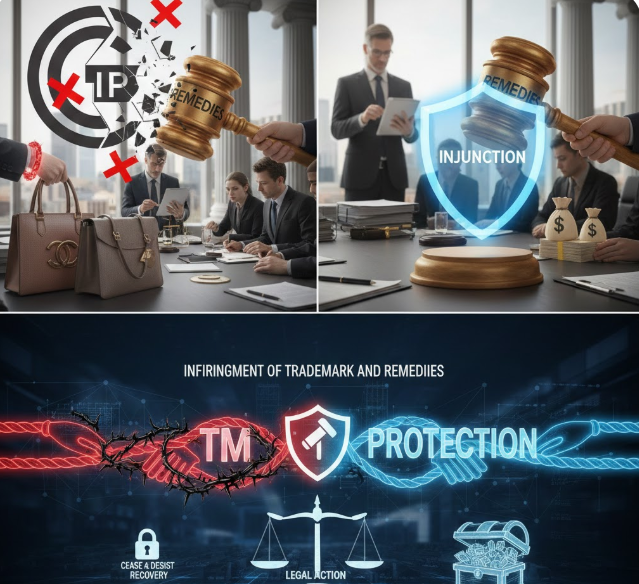
Infringement of trademark and remedies is not just a legal topic. It is a commercial reality that affects brand value, market trust, and long-term business growth. Companies invest years and significant capital building trademarks, only to see that value diluted or misappropriated through unauthorized use. When infringement occurs, understanding the available remedies is the difference between protecting a brand and slowly losing control over it.
This page is written as authoritative, experience-driven page content, not abstract theory. It explains what trademark infringement really means, how courts and authorities assess it, and what remedies are practically available. The discussion reflects real enforcement strategies used by rights holders and legal professionals, including those advised by Prip LLC, where trademark protection is treated as a strategic business asset rather than a paperwork exercise.
Understanding the Concept of Trademark Infringement
A trademark is more than a logo or a name. It represents the source, quality, and goodwill of goods or services. Trademark infringement occurs when a third party uses a mark that is identical or deceptively similar to a registered trademark in a way that causes confusion among consumers.
The key point is confusion. Courts do not merely look at visual similarity. They evaluate the overall commercial impression.
Core elements of trademark infringement
To establish infringement, most legal systems require proof of the following:
-
Existence of a valid registered trademark
-
Unauthorized use by another party
-
Use in the course of trade or business
-
Likelihood of confusion or deception
-
Damage or potential damage to trademark owner
Infringement of trademark and remedies are always analyzed together because infringement without an effective remedy renders trademark rights meaningless.
Why Trademark Infringement Is a Serious Business Risk
Many businesses underestimate trademark infringement until it directly impacts them. In reality, infringement affects multiple layers of a business.
Commercial consequences of trademark infringement
-
Loss of brand exclusivity
-
Customer confusion and erosion of trust
-
Damage to reputation and goodwill
-
Revenue diversion to infringers
-
Increased legal and enforcement costs
From a strategic standpoint, Prip LLC treats trademark infringement as both a legal and commercial threat that requires early detection and decisive action.
Types of Trademark Infringement
Trademark infringement is not a single-form violation. It appears in multiple ways depending on intent, industry, and market behavior.
Direct infringement
This occurs when an identical or deceptively similar mark is used for identical or similar goods or services.
Examples:
-
Copying a brand name on competing products
-
Using a similar logo on the same category of goods
Indirect infringement
Indirect infringement involves parties who facilitate or benefit from infringement.
Examples:
-
Distributors knowingly selling counterfeit goods
-
Online marketplaces allowing repeated infringing listings
Counterfeiting
Counterfeiting is the most severe form of trademark infringement.
Characteristics:
-
Exact replication of a registered mark
-
Intentional deception
-
Often linked to criminal liability
Passing off (common law infringement)
Even without registration, a business may claim protection if it can prove goodwill and misrepresentation. Passing off is closely related but legally distinct from statutory infringement.
Trademark Infringement vs Trademark Dilution
Not all trademark harm involves confusion.
Trademark dilution explained
Dilution occurs when a famous or well-known trademark is used in a manner that weakens its distinctiveness or reputation, even if consumers are not confused.
Types of dilution:
-
Dilution by blurring
-
Dilution by tarnishment
In infringement of trademark and remedies discussions, dilution is increasingly relevant for global brands and digital businesses.
How Courts Determine Trademark Infringement
Courts rely on established tests rather than subjective impressions.
Key factors considered by courts
-
Visual, phonetic, and conceptual similarity
-
Nature of goods or services
-
Class of consumers and purchasing behavior
-
Trade channels used
-
Intention of the infringer
-
Evidence of actual confusion (if available)
No single factor is decisive. Courts look at the overall commercial effect.
Role of Registration in Trademark Infringement Cases
Trademark registration significantly strengthens enforcement rights.
Benefits of registration
-
Presumption of ownership
-
Exclusive statutory rights
-
Easier access to remedies
-
Stronger deterrent effect
While unregistered marks may be protected under passing off, remedies are limited and harder to prove.
This is why Prip LLC emphasizes proactive trademark registration as the first layer of infringement prevention.
Remedies for Trademark Infringement: An Overview
Remedies are the enforcement tools available to a trademark owner after infringement is established.
Objectives of trademark remedies
-
Stop unauthorized use
-
Prevent future infringement
-
Compensate the trademark owner
-
Deter others from infringing
Infringement of trademark and remedies must be understood as a system, not isolated legal actions.
Civil Remedies for Trademark Infringement
Civil remedies are the most commonly used enforcement mechanisms.
Injunctions
An injunction is a court order restraining the infringer from continuing the infringing activity.
Types:
-
Temporary injunction
-
Permanent injunction
In practice, injunctions are often the most powerful remedy because they stop infringement immediately.
Damages
Damages compensate the trademark owner for losses suffered due to infringement.
Courts may consider:
-
Loss of sales
-
Damage to goodwill
-
Unfair profits earned by infringer
Account of profits
Instead of damages, a trademark owner may claim the profits earned by the infringer through unauthorized use.
This remedy focuses on disgorgement, not compensation.
Delivery up and destruction
Courts may order seizure and destruction of infringing goods, packaging, labels, and promotional material.
Criminal Remedies in Trademark Infringement
In some jurisdictions, trademark infringement attracts criminal liability, especially in counterfeiting cases.
Criminal sanctions may include
-
Fines
-
Imprisonment
-
Search and seizure of goods
Criminal remedies are intended to punish and deter rather than compensate.
Prip LLC often evaluates whether civil or criminal enforcement—or a combination—is strategically appropriate.
Administrative and Border Enforcement Remedies
Trademark enforcement is not limited to courts.
Customs and border protection
Trademark owners can record trademarks with customs authorities to prevent import of counterfeit goods.
Benefits:
-
Early interception
-
Reduced market entry of infringing products
Online platform takedowns
Digital infringement is addressed through:
-
Notice and takedown procedures
-
Platform IP protection programs
These remedies are faster but require proper documentation and monitoring.
Pros & Cons of Trademark Infringement Remedies
| Aspect | Pros | Cons |
|---|---|---|
| Injunctions | Immediate relief | Requires strong prima facie case |
| Damages | Financial compensation | Difficult to quantify |
| Account of profits | Strips infringer’s gain | Complex financial proof |
| Criminal remedies | Strong deterrent | Higher burden of proof |
| Administrative action | Faster resolution | Limited scope |
Choosing the Right Remedy: A Strategic Decision
Not every infringement requires litigation.
Factors influencing remedy selection
-
Scale of infringement
-
Market impact
-
Intent of infringer
-
Jurisdictional costs
-
Speed of relief required
Effective enforcement balances legal strength with business practicality.
Defenses Available in Trademark Infringement Cases
Understanding defenses is essential for both plaintiffs and defendants.
Common defenses
-
No likelihood of confusion
-
Honest concurrent use
-
Prior use
-
Descriptive or fair use
-
Invalidity of trademark
In infringement of trademark and remedies disputes, defenses often shape settlement outcomes.
Trademark Infringement in the Digital and E-Commerce Era
Online infringement has transformed trademark enforcement.
Common online infringement forms
-
Domain name misuse
-
Social media impersonation
-
Marketplace counterfeits
-
Sponsored keyword abuse
Digital enforcement requires constant monitoring and swift action.
International Dimensions of Trademark Infringement
Global businesses face cross-border infringement challenges.
Key complexities
-
Different legal standards
-
Jurisdictional conflicts
-
Enforcement costs
-
Parallel proceedings
This is where firms like Prip LLC play a crucial role by coordinating international trademark strategies.
Preventive Measures Against Trademark Infringement
The best remedy is prevention.
Effective prevention strategies
-
Strong trademark registration portfolio
-
Regular trademark monitoring
-
Clear licensing agreements
-
Enforcement guidelines
-
Rapid response protocols
Proactive protection reduces long-term enforcement costs.
Role of Settlement and Alternative Dispute Resolution
Not all cases should go to trial.
Benefits of settlement
-
Faster resolution
-
Cost efficiency
-
Confidentiality
-
Preservation of business relationships
ADR mechanisms are often overlooked but highly effective in trademark disputes.
Trademark Infringement and Remedies: Industry-Specific Insights
Different industries face different infringement risks.
High-risk industries
-
Fashion and luxury goods
-
Pharmaceuticals
-
Consumer electronics
-
Software and digital services
Each requires tailored enforcement strategies.
Economic Impact of Trademark Infringement
Trademark infringement is not victimless.
Broader economic effects
-
Reduced innovation incentives
-
Consumer safety risks
-
Tax revenue loss
-
Employment impact
Strong enforcement benefits the entire marketplace.
Why Businesses Rely on Prip LLC for Trademark Enforcement
Prip LLC approaches infringement of trademark and remedies with a business-first mindset.
Key principles:
-
Strategic enforcement over aggressive litigation
-
Cost-benefit driven decisions
-
Cross-border coordination
-
Long-term brand protection focus
This approach ensures trademark rights are enforced effectively without unnecessary disruption.
Common Mistakes Trademark Owners Make
-
Delaying enforcement
-
Inconsistent action
-
Poor evidence preservation
-
Overlooking online infringement
-
Underestimating small infringers
Early action prevents escalation.
Frequently Asked Questions
1. What is trademark infringement?
Trademark infringement occurs when a person or business uses a mark that is identical or deceptively similar to a registered trademark in a way that is likely to confuse consumers about the source of goods or services.
2. Is trademark infringement possible without exact copying?
Yes. Exact copying is not required. Even a similar-looking, similar-sounding, or conceptually similar mark can amount to infringement if it creates a likelihood of confusion in the marketplace.
3. Do I need a registered trademark to claim infringement?
In most jurisdictions, statutory trademark infringement requires a registered trademark. However, unregistered trademarks may still be protected under common law through passing-off actions, though remedies are more limited and harder to prove.
4. What remedies are available for trademark infringement?
Common remedies include injunctions to stop the infringement, monetary damages, account of profits, delivery and destruction of infringing goods, and in serious cases, criminal penalties such as fines or imprisonment.
5. What is the most effective remedy for trademark infringement?
An injunction is often the most effective remedy because it immediately stops the infringing activity and prevents further damage to the trademark owner’s rights.
6. Can trademark infringement lead to criminal liability?
Yes. In cases involving counterfeiting or willful infringement, criminal remedies may apply. These can include fines, seizure of goods, and imprisonment, depending on the jurisdiction.
7. How is “likelihood of confusion” determined?
Courts consider factors such as similarity of marks, similarity of goods or services, nature of consumers, trade channels, and evidence of actual confusion. No single factor is decisive; the overall commercial impression is assessed.
8. Can online trademark infringement be enforced?
Yes. Trademark owners can enforce rights against online infringement through court actions, domain name dispute procedures, platform takedown mechanisms, and e-commerce marketplace reporting systems.
9. What defenses are commonly used in trademark infringement cases?
Common defenses include absence of confusion, honest or prior use, descriptive or fair use, invalidity of the trademark, and lack of use in the course of trade.
10. How can businesses prevent trademark infringement?
Preventive measures include registering trademarks early, monitoring the market and online platforms, enforcing rights consistently, maintaining proper licensing agreements, and acting quickly when infringement is detected.
