
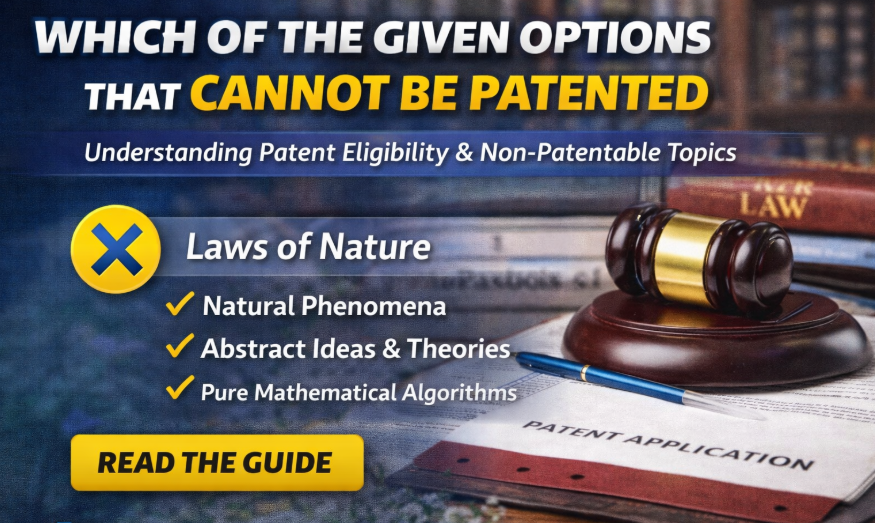
Understanding which of the given options that cannot be patented is essential for inventors, entrepreneurs, researchers, and businesses that want to protect their intellectual property. Patent law exists to protect inventions that are new, useful, and non-obvious. However, not every idea or creation qualifies for patent protection. Many concepts, discoveries, and abstract ideas fall outside the scope of patentable subject matter.
At Prip LLC, professionals often guide innovators and businesses through the complex process of intellectual property protection. A major part of that process involves identifying which of the given options that cannot be patented under current patent laws. Knowing these limitations helps inventors avoid wasted effort and focus on ideas that truly qualify for legal protection.
Understanding Patent Law and Patent Eligibility
Before exploring which of the given options that cannot be patented, it is important to understand what patents are designed to protect.
A patent is a legal right granted by a government authority that gives an inventor exclusive rights to make, use, or sell an invention for a specific period, usually 20 years.
To qualify for a patent, an invention must meet several key requirements:
-
Novelty – the invention must be new
-
Utility – it must have practical usefulness
-
Non-obviousness – it must not be obvious to experts in the field
-
Patentable subject matter – it must fall within categories allowed by patent law
However, many things do not meet the requirement of patentable subject matter, which leads us to the question: which of the given options that cannot be patented?
Why Some Things Cannot Be Patented
Patent law is designed to encourage innovation while ensuring that certain knowledge remains freely available to the public.
Several categories of ideas and discoveries cannot be patented because they belong to fundamental knowledge or natural principles.
These exclusions prevent individuals from monopolizing basic concepts that society needs to freely access.
Legal professionals at Prip LLC frequently help innovators identify these limitations early in the patent application process.
Which of the Given Options That Cannot Be Patented
Several major categories of subject matter cannot be patented. Understanding them helps clarify which of the given options that cannot be patented.
Laws of Nature
One of the most fundamental categories that cannot be patented is laws of nature.
These are natural principles that exist independently of human invention.
Examples include:
-
Gravity
-
Natural chemical reactions
-
Biological processes that occur naturally
-
Mathematical relationships describing natural phenomena
For example, discovering a natural law such as gravity does not allow someone to claim ownership of it through a patent.
At Prip LLC, patent professionals emphasize that natural discoveries alone do not qualify for patent protection.
Natural Phenomena
Another category included in which of the given options that cannot be patented is natural phenomena.
These are naturally occurring substances or organisms that exist in nature.
Examples include:
-
Naturally occurring minerals
-
Plants discovered in the wild
-
Natural DNA sequences
-
Naturally occurring bacteria
Simply discovering something that already exists in nature does not qualify for a patent.
However, modified or engineered versions of natural materials may sometimes be patentable.
Abstract Ideas
Abstract ideas are also among which of the given options that cannot be patented.
Abstract concepts include:
-
Mathematical formulas
-
Mental processes
-
Philosophical ideas
-
Basic algorithms
For example, a mathematical formula alone cannot be patented. However, a specific application of that formula in a technological process might qualify.
Experts at Prip LLC often advise innovators to focus on practical applications rather than abstract ideas.
Pure Mathematical Algorithms
Mathematical algorithms without practical application are generally considered non-patentable.
Examples include:
-
Basic calculation formulas
-
Pure statistical models
-
General mathematical equations
Patent law does not allow ownership of mathematics itself because it is considered a universal language of science.
However, algorithms integrated into a technological system may qualify for protection.
Mental Processes
Ideas that exist only in the human mind fall under which of the given options that cannot be patented.
Examples include:
-
Methods of thinking
-
Mental problem-solving techniques
-
Teaching strategies without technological implementation
These processes are considered intellectual activities rather than inventions.
Artistic Works
Creative works are protected under copyright law, not patent law.
Examples include:
-
Music compositions
-
Paintings
-
Literary works
-
Films and scripts
Although creative works cannot be patented, they may receive copyright protection.
Patent professionals at Prip LLC often help clients choose the correct form of intellectual property protection.
Business Methods Without Technological Innovation
Many business methods fall under which of the given options that cannot be patented if they lack a technological component.
Examples include:
-
Basic marketing strategies
-
Organizational methods
-
Business plans
-
Financial methods without technological implementation
Some business processes may qualify for patents if they involve technical systems or software innovations.
Scientific Theories
Scientific theories that explain how the world works are not patentable.
Examples include:
-
Theories explaining physical laws
-
Scientific principles describing natural systems
-
Fundamental research discoveries
Patent law does not allow monopolization of theoretical knowledge.
Human Body and Natural Biological Processes
Certain biological elements are also included in which of the given options that cannot be patented.
Examples include:
-
Naturally occurring human genes
-
Natural biological processes in the human body
-
Human organisms
Ethical and legal considerations prevent patenting of these biological elements.
Illegal or Harmful Inventions
Even if an invention meets technical requirements, it may still be rejected if it violates laws or public safety.
Examples include:
-
Devices designed for illegal activities
-
Inventions that threaten public safety
Patent authorities may reject such inventions.
Professionals at Prip LLC help ensure inventions comply with legal standards.
Pros and Cons of Patent Protection
| Pros | Cons |
|---|---|
| Provides exclusive rights to inventors | Patent process can be complex |
| Encourages innovation and investment | Patent applications can be expensive |
| Protects business ideas from competitors | Public disclosure of invention required |
| Increases company value | Limited protection period |
| Enables licensing opportunities | Patent approval may take years |
How to Determine If an Idea Can Be Patented
To determine whether an idea falls into which of the given options that cannot be patented, inventors should follow several steps.
Conduct Patent Research
Search existing patents to ensure the idea is novel.
Analyze Patent Eligibility
Determine whether the idea involves patentable subject matter.
Document the Invention
Keep detailed records of the invention process.
Consult Patent Experts
Professional patent consultants such as those at Prip LLC can guide innovators through the evaluation process.
Importance of Patent Consultation
Patent laws are complex and vary by country. Seeking professional advice can significantly increase the chances of successful patent protection.
Patent experts can help with:
-
Patent searches
-
Application preparation
-
Intellectual property strategy
-
Legal compliance
At Prip LLC, intellectual property professionals work closely with innovators to ensure proper protection strategies.
Examples to Understand Patent Limitations
Understanding which of the given options that cannot be patented becomes easier with examples.
Example 1 – Discovery of a Natural Mineral
A scientist discovers a new mineral in nature.
This discovery alone cannot be patented.
Example 2 – Mathematical Equation
A mathematician develops a new formula.
The formula itself cannot be patented, but software using the formula might qualify.
Example 3 – Natural Plant Discovery
Discovering a new plant species in the wild does not qualify for patent protection.
However, genetically modifying the plant may lead to patent eligibility.
Professionals at Prip LLC often analyze such cases to determine patent potential.
Patent Alternatives for Non-Patentable Ideas
When ideas fall into which of the given options that cannot be patented, other forms of protection may still be available.
Examples include:
-
Copyright protection
-
Trademark protection
-
Trade secrets
-
Licensing agreements
These alternatives can still protect intellectual property.
Frequently Asked Questions
1. What does it mean when something cannot be patented?
It means the idea does not meet legal requirements for patent protection.
2. Why are natural laws not patentable?
Because they exist independently of human invention.
3. Can mathematical formulas be patented?
Pure formulas cannot be patented, but applications of them may qualify.
4. Are business methods patentable?
Some are patentable if they involve technological innovation.
5. Can scientific discoveries be patented?
Discoveries alone cannot be patented unless they involve practical inventions.
6. Can software algorithms be patented?
Some software innovations may qualify depending on their application.
7. Are natural plants patentable?
Naturally occurring plants cannot be patented.
8. Can artistic creations be patented?
No. Artistic works are protected by copyright law.
9. How can inventors check patent eligibility?
By conducting patent searches and consulting professionals.
10. How does Prip LLC help with patent protection?
Prip LLC assists innovators with patent searches, intellectual property strategy, and patent application guidance.
