
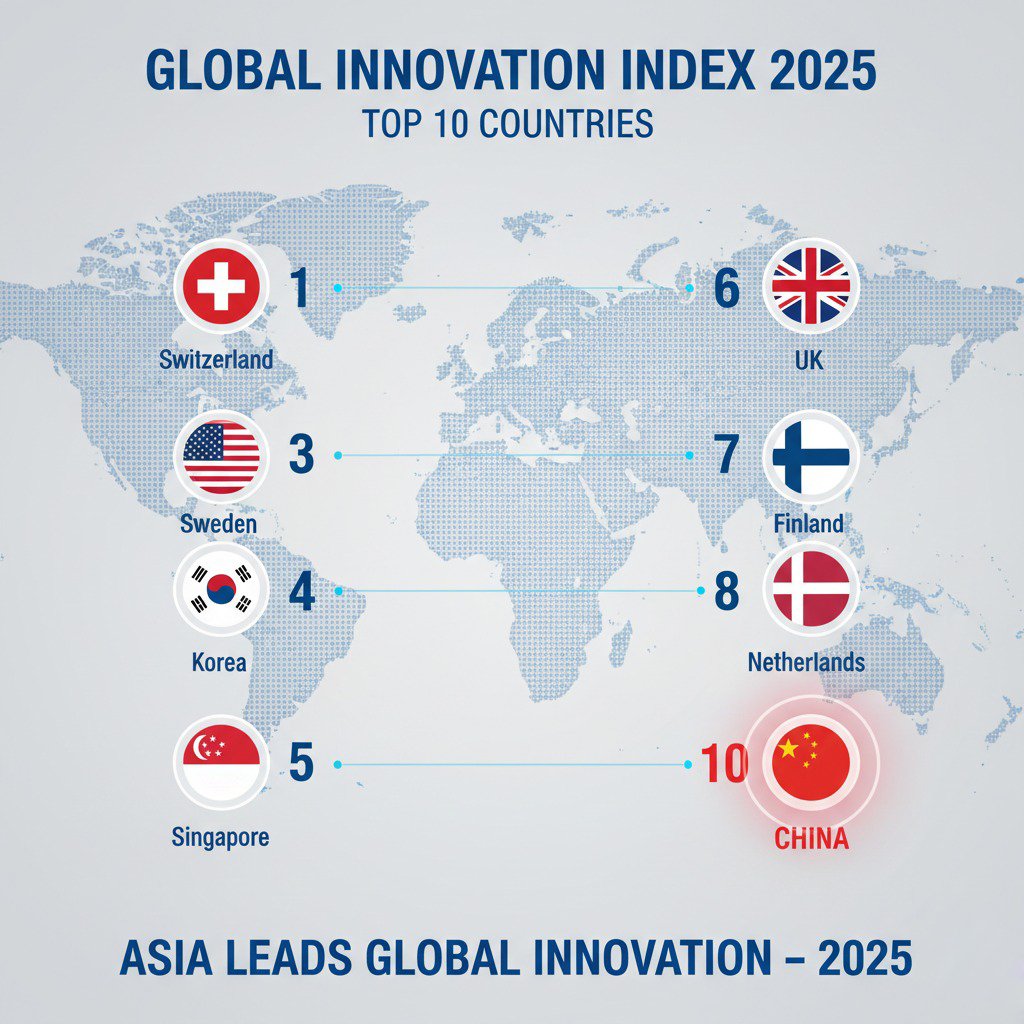
Asia has once again demonstrated its remarkable prowess in innovation, intellectual property (IP), and economic development. September 2025 has brought a wave of significant updates that reflect the region’s growing influence in global technology, IP systems, and collaborative frameworks. From China’s leap into the top 10 of the Global Innovation Index to Korea’s expanding ties with ASEAN nations, and updates from Japan, Hong Kong, and other IP offices, these developments are shaping the future of innovation across Asia. In this article, we will explore these updates in depth, analyze their implications, and provide insights for businesses, policymakers, and innovators.
🚀 China Enters the Global Innovation Index Top 10
For the first time in history, China has been ranked 10th overall in the Global Innovation Index (GII), marking a significant milestone for the nation and highlighting its growing prominence in the global innovation ecosystem. What makes this achievement particularly remarkable is that China leads among middle-income economies-a feat that underscores its transition from a manufacturing hub to an innovation-driven economy.
Key Drivers of China’s Innovation Growth:
-
R&D Spending:
China’s investment in research and development continues to surge, with billions of dollars funneled into technology, AI, biotech, and green energy sectors. This long-term commitment has created a strong foundation for cutting-edge innovations and patents. -
High-Tech Exports:
The country’s high-tech exports, particularly in electronics, telecommunications, AI hardware, and biotech products, have steadily increased. These exports not only demonstrate China’s technological capabilities but also solidify its role in global supply chains. -
Innovation Clusters:
China has developed multiple innovation hubs that foster collaboration between universities, research institutes, startups, and large corporations. The Shenzhen-Hong Kong-Guangzhou cluster has now become the largest global innovation hub, surpassing Tokyo-Yokohama. This cluster attracts talent, capital, and cutting-edge research, establishing itself as a critical engine for technological growth in the Asia-Pacific region.
Implications for Businesses and IP:
-
Patent Opportunities: With a booming R&D environment, China is likely to see a surge in domestic patent filings and international collaborations. Companies should monitor this landscape to identify partnerships and licensing opportunities.
-
Market Expansion: Multinational corporations can leverage China’s innovation hubs to access advanced technologies and enter high-growth sectors.
-
Strategic IP Protection: Businesses engaging in China must ensure robust IP strategies to protect their innovations in a competitive market.
🤝 Korea (KIPO) Deepens IP Ties with ASEAN
The Korean Intellectual Property Office (KIPO) has been actively expanding its cooperation with ASEAN countries and Timor-Leste, focusing on intellectual property, AI, and IP finance. This move reinforces Korea’s commitment to fostering regional innovation ecosystems and strengthening IP protection frameworks.
Highlights of KIPO’s ASEAN Engagement:
-
Bilateral Meetings:
KIPO held discussions with eight ASEAN member states and Timor-Leste, addressing shared challenges in IP protection, enforcement, and innovation commercialization. -
MoU with Singapore:
A significant milestone was achieved with the signing of a Memorandum of Understanding (MoU) with Singapore. This agreement focuses on AI, IP financing, and commercialization strategies, aiming to facilitate technology transfer and strengthen innovation networks. -
Work Plans with Vietnam, Indonesia & Cambodia:
Korea is collaborating with these nations to enhance laws, trademark systems, and IP protection frameworks. These efforts include capacity building, technical assistance, and knowledge sharing, ensuring that emerging economies can efficiently safeguard their innovations. -
Supporting Timor-Leste:
KIPO is assisting Timor-Leste in establishing its own IP office, laying the foundation for a national IP system that will support local innovation and economic development.
Why This Matters:
-
Regional Collaboration: Strengthening IP ties in Asia ensures a more secure and predictable environment for innovators and investors.
-
Technology Commercialization: By focusing on AI and IP finance, Korea is enabling startups and enterprises to monetize their innovations effectively.
-
Capacity Building: Emerging economies benefit from knowledge transfer and technical support, which accelerates their participation in global innovation networks.
🇯🇵 Japan (JPO) & EUIPO Strengthen Cooperation
Japan’s Intellectual Property Office (JPO) has expanded its collaboration with the European Union Intellectual Property Office (EUIPO), emphasizing trademarks and design protection. This partnership reflects a growing trend of cross-regional IP harmonization, which simplifies processes for international businesses.
Key Points:
-
Focus Areas: Trademarks and designs are at the center of the cooperation, helping businesses safeguard brand identity and product innovations.
-
User-Friendly Systems: Both offices are committed to making IP systems more accessible and efficient, reducing bureaucratic barriers and improving service quality.
-
Global Alignment: Harmonization of IP standards benefits businesses operating in multiple jurisdictions, fostering a more seamless international trade and innovation environment.
Implications for Companies:
-
Enhanced IP Security: Companies can benefit from consistent rules across major markets, reducing legal uncertainties.
-
Ease of Filing: Simplified processes encourage startups and SMEs to register and protect their IP.
-
Strategic Planning: Businesses can better plan product launches, branding, and international expansion with aligned IP systems.
🇭🇰 Hong Kong Updates Patent Examination Guidelines
The Hong Kong Intellectual Property Department has introduced major revisions to its Patent Examination Guidelines, affecting novelty, inventive step, patentability exclusions, specifications, and applications. These updates also include new declaration requirements for local agents.
What Changed:
-
Novelty and Inventive Step: The revisions clarify the assessment criteria for patent applications, ensuring that only truly innovative inventions receive protection.
-
Exclusions from Patentability: Certain categories of inventions, such as abstract ideas or natural phenomena, are explicitly outlined as non-patentable.
-
Specifications & Applications: Enhanced guidance on drafting patent applications ensures higher-quality submissions.
-
Local Agent Declarations: New requirements streamline verification processes and strengthen compliance.
Implications:
-
Quality of Patents: Higher standards improve the overall value and enforceability of patents in Hong Kong.
-
Strategic Filings: Innovators should carefully review applications to align with the new guidelines.
-
Business Planning: Companies can anticipate patent approval timelines and adjust R&D priorities accordingly.
🔎 Broader Trends in Asian IP & Innovation
The September 2025 updates highlight several key trends that are shaping Asia’s innovation landscape:
-
Rising Global Influence: Countries like China, Korea, and Japan are strengthening their role in global innovation, creating hubs that rival traditional centers in Europe and North America.
-
Cross-Border Cooperation: Regional and international collaborations are increasing, particularly in IP harmonization, AI commercialization, and technology transfer.
-
Regulatory Evolution: Countries are refining patent and IP guidelines to foster innovation while maintaining rigorous standards for protection.
-
Emerging Markets: Nations like Timor-Leste are entering the IP landscape, supported by knowledge transfer from more advanced economies.
-
Sectoral Focus: Technology, AI, biotech, high-tech manufacturing, and IP finance are gaining strategic importance, driving policy and investment decisions.
🌐 Implications for Businesses and Innovators
These developments have profound implications for companies, startups, and inventors across Asia and beyond:
-
Strategic IP Management: Businesses must actively monitor updates in patent laws, trademark systems, and examination guidelines to protect their innovations.
-
Opportunities for Collaboration: Cross-border partnerships and MoUs create pathways for joint ventures, licensing, and technology transfer.
-
Investment Insights: Investors can leverage innovation hubs and emerging IP ecosystems to identify high-growth opportunities.
-
Global Competitiveness: Countries that strengthen IP protection and support innovation are likely to attract talent, capital, and international businesses.
-
Risk Mitigation: Understanding local IP regulations helps mitigate legal risks and avoid infringement disputes.
💡 Question for You
Asia is rapidly evolving as a global innovation powerhouse. Among these developments—from China’s rise in the Global Innovation Index to Korea’s deepening ties with ASEAN, Japan-EUIPO cooperation, and Hong Kong’s patent reforms—which country’s move do you think will have the biggest impact in the next 5 years?
Your insights could help innovators and businesses anticipate trends, plan IP strategies, and capitalize on opportunities in this dynamic region.
🔑 Key Takeaways
-
China has entered the top 10 in the Global Innovation Index, reflecting its growing technological and economic influence.
-
Korea is expanding IP cooperation with ASEAN, fostering regional innovation ecosystems and commercialization of AI and technology.
-
Japan & EUIPO collaboration streamlines trademarks and designs, enhancing international IP alignment.
-
Hong Kong revises patent guidelines to improve quality, clarity, and enforceability of patents.
-
Emerging Asian markets are being supported with IP frameworks, opening new pathways for innovation and growth.
Asia’s focus on IP, innovation, and collaboration demonstrates the continent’s role as a key driver of global technology, trade, and economic expansion. For businesses and innovators, staying informed and strategically aligned with these developments is essential for long-term success.
