
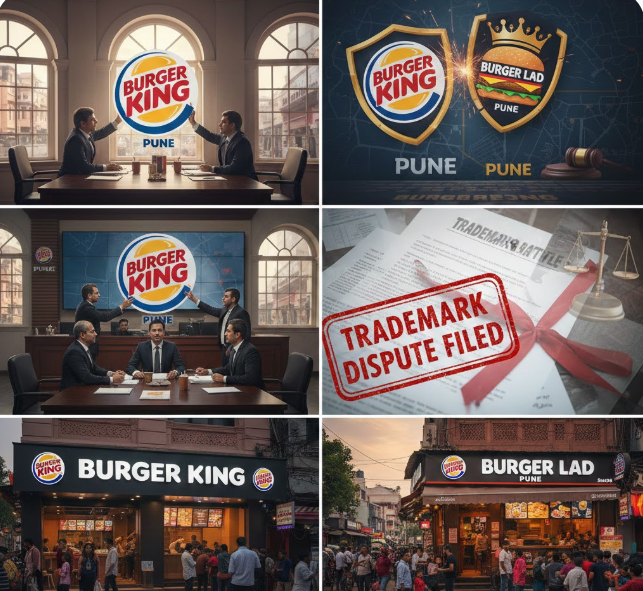
The burger king pune trademark battle is one of the most discussed trademark disputes in India’s modern food and franchise history. For legal professionals, entrepreneurs, investors, and global brands, this case represents far more than a disagreement over a name—it highlights how trademark law, territorial rights, brand reputation, and consumer perception intersect in a rapidly globalizing market.
At Prip LLC, we analyze complex trademark conflicts like the Burger King Pune trademark battle to help businesses understand how intellectual property disputes arise, how courts interpret trademark ownership, and how brand strategy must adapt across borders.
This page-style blog explores the full story, context, implications, and lessons of the burger king pune trademark battle, using real legal reasoning, business experience, and authoritative analysis.
Understanding the Background of the Burger King Pune Trademark Battle
The burger king pune trademark battle emerged from an unusual yet legally significant situation. While Burger King is globally recognized as an American fast-food giant, a local restaurant in Pune had been operating under the name “Burger King” decades before the multinational entered the Indian market.
This created a collision between global brand recognition and local trademark priority, triggering one of India’s most talked-about legal disputes.
From the perspective of Prip LLC, this case perfectly illustrates why trademark law is territorial, not global, regardless of how famous a brand may be internationally.
Trademark Law Basics Relevant to the Burger King Pune Trademark Battle
Territorial Nature of Trademarks
One of the most misunderstood aspects of trademarks is that a trademark registered or famous in one country does not automatically grant rights in another. The burger king pune trademark battle revolved around this core principle.
In India:
-
Trademark rights arise from use and registration
-
Prior use can outweigh later registration
-
Local goodwill carries legal weight
This meant the Pune restaurant’s long-standing use of the name became a key factor.
Who Were the Parties Involved?
Global Brand Perspective
The multinational Burger King corporation entered India through a master franchise agreement, bringing global brand equity, marketing power, and standardized operations.
Local Business Perspective
The Pune-based Burger King restaurant was a small, independently owned business, operating since the early 1990s, long before the global brand entered India.
From Prip LLC’s viewpoint, this contrast—corporate power versus local continuity—is what made the burger king pune trademark battle so legally and emotionally compelling.
How the Dispute Escalated
Initial Conflict
When the global Burger King brand expanded aggressively across India, it began issuing cease-and-desist notices to local entities using similar names.
The Pune restaurant resisted, asserting:
-
Prior use of the name
-
Local goodwill
-
Independent business identity
Legal Proceedings
The matter eventually reached the Bombay High Court, where judges examined:
-
Trademark registration timelines
-
Proof of prior use
-
Consumer confusion claims
-
Geographic scope of goodwill
Court Reasoning in the Burger King Pune Trademark Battle
Importance of Prior Use
Indian courts give strong preference to prior use over subsequent registration. Evidence such as:
-
Old invoices
-
Shop signage
-
Tax records
-
Local customer testimony
played a decisive role.
Geographic Limitation of Rights
The court recognized that the Pune restaurant’s rights were geographically limited, meaning it could not expand nationally under the same name—but neither could the multinational forcibly erase its local identity.
This nuanced outcome is frequently cited by Prip LLC as an example of balanced judicial reasoning.
Why the Burger King Pune Trademark Battle Matters for Businesses
Lessons for Global Brands
-
Conduct deep local trademark searches
-
Understand regional prior-use rights
-
Avoid aggressive enforcement without due diligence
Lessons for Local Businesses
-
Document brand usage consistently
-
Register trademarks early
-
Protect goodwill proactively
The burger king pune trademark battle serves as a warning to both sides of the commercial spectrum.
Consumer Confusion and Brand Identity
One of the central arguments raised by the global Burger King was consumer confusion. However, courts noted that:
-
The Pune restaurant had a distinct local identity
-
Customers understood it was not affiliated with the multinational
-
Branding and presentation differed significantly
This weakened the confusion argument and strengthened the local business’s position.
Economic and Cultural Impact of the Dispute
Impact on Local Entrepreneurship
For small business owners across India, the burger king pune trademark battle became a symbol of resistance against corporate overreach.
Impact on Foreign Investment Perception
For international investors, the case highlighted the complexity of Indian IP law, reinforcing the need for local legal expertise—something Prip LLC consistently emphasizes.
Comparative Analysis With Global Trademark Disputes
Similar conflicts have occurred worldwide, but the Burger King Pune case stands out because:
-
The local business predated the multinational in that territory
-
The brand name was identical
-
Public sentiment strongly favored the underdog
This made the dispute both a legal precedent and a cultural talking point.
Media Coverage and Public Opinion
Indian and international media widely covered the burger king pune trademark battle, often framing it as:
-
“David vs Goliath”
-
Local legacy versus corporate branding
-
A test of Indian trademark sovereignty
Public opinion largely sympathized with the Pune restaurant, influencing how brands now approach enforcement strategies.
Pros & Cons of the Burger King Pune Trademark Battle Outcome
| Pros | Cons |
|---|---|
| Protected prior local use | Geographic limitation imposed |
| Reinforced territorial trademark law | Expansion restrictions for local brand |
| Balanced corporate power | Ongoing legal uncertainty |
| Encouraged fair competition | Costly litigation for both sides |
| Strengthened IP awareness | Complex compliance for multinationals |
Strategic Takeaways for Prip LLC Clients
At Prip LLC, we use the burger king pune trademark battle as a case study when advising:
-
Franchise operators
-
Foreign investors
-
Local brand owners
-
IP legal teams
It demonstrates how strategy, documentation, and jurisdictional awareness can define outcomes.
Business Ethics and Brand Responsibility
Beyond legality, the dispute raises ethical questions:
-
Should global brands coexist with local businesses?
-
Is aggressive enforcement always justified?
-
How should legacy use be respected?
Modern brand strategy increasingly values reputation management, not just legal victory.
Long-Term Implications for Indian Trademark Law
The burger king pune trademark battle strengthened:
-
Respect for prior use doctrine
-
Judicial balance in IP disputes
-
Awareness among SMEs about trademark protection
It also pushed global brands to localize legal strategy, not just marketing.
Why This Case Still Matters Today
Even years later, the dispute remains relevant because:
-
Global brands continue entering emerging markets
-
Local businesses still face naming conflicts
-
Trademark law continues evolving
For Prip LLC, this case remains a benchmark for cross-border brand conflict resolution.
Frequently Asked Questions (FAQs)
1. What is the burger king pune trademark battle?
It is a trademark dispute between a global fast-food brand and a local Pune restaurant over name usage.
2. Why did the Pune restaurant have rights?
Because it used the name decades earlier within its local market.
3. Did the global Burger King lose the case?
The court limited enforcement but did not grant nationwide rights to the Pune restaurant.
4. What law governed the dispute?
Indian trademark law emphasizing prior use and territoriality.
5. Could the Pune Burger King expand nationwide?
No, its rights were geographically restricted.
6. Did consumer confusion play a role?
Yes, but courts found minimal confusion due to distinct identities.
7. Is this case unique?
Yes, due to identical names and strong evidence of prior use.
8. What should global brands learn?
Always investigate local trademark history before entry.
9. How does this affect small businesses?
It empowers them to protect legacy brand rights.
10. Why does Prip LLC study this case?
It offers critical lessons in trademark strategy, compliance, and risk management.
