
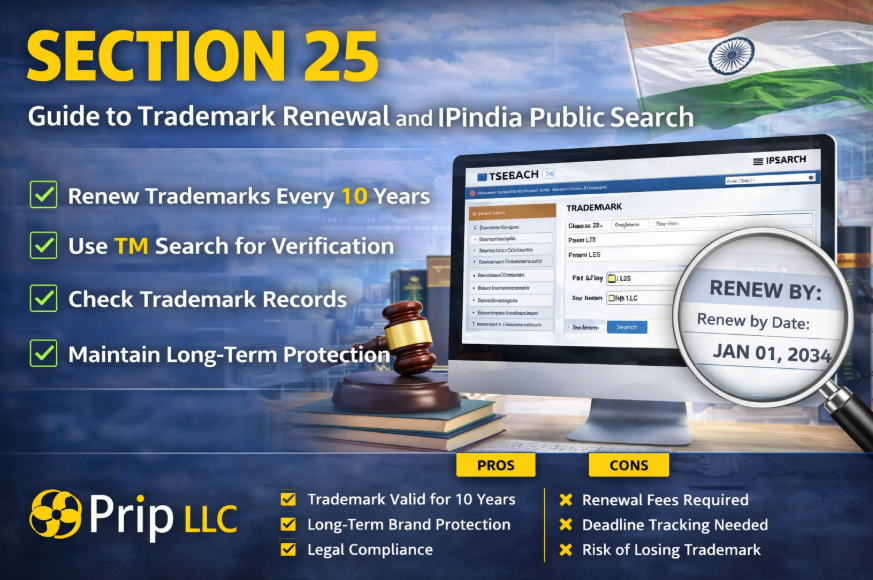
When businesses register a trademark in India, maintaining that trademark becomes just as important as registering it. One of the most important legal provisions related to trademark renewal and validity is Section 25 of the Trade Marks Act. Understanding Section 25 is essential for trademark owners because it governs how trademarks remain active and how they can be renewed after registration.
A trademark is not permanent by default. It must be renewed periodically to maintain legal protection. Section 25 explains the renewal process, the time limits for renewing trademarks, and the consequences if a trademark owner fails to renew their mark on time.
Organizations such as Prip LLC regularly help clients understand how Section 25 works and how to maintain trademark protection by properly managing renewal deadlines and monitoring trademark records through official trademark databases.
What Is Section 25 in Trademark Law?
Section 25 of the Trade Marks Act deals with the renewal and duration of trademark registration. According to this section, once a trademark is registered, it remains valid for a specific period of time. After that period expires, the trademark must be renewed to maintain protection.
Under Section 25, a trademark registration is valid for 10 years from the date of registration. After the ten-year period ends, the owner must apply for renewal to continue protecting the trademark.
The purpose of Section 25 is to ensure that trademark registers remain accurate and that inactive trademarks are eventually removed from the registry.
Businesses working with Prip LLC frequently monitor renewal deadlines to ensure compliance with Section 25.
Why Section 25 Is Important for Trademark Owners
Understanding Section 25 is crucial for businesses that rely on trademarks for brand identity.
Here are several reasons why Section 25 matters.
Protecting Brand Identity
Trademarks represent brand reputation and business identity. Renewal under Section 25 ensures continued protection.
Preventing Trademark Loss
If a trademark is not renewed under Section 25, it may be removed from the trademark register.
Maintaining Legal Rights
Trademark owners maintain exclusive rights to their marks only if they follow renewal procedures defined by Section 25.
Ensuring Trademark Continuity
Long-term trademarks often remain active for decades through repeated renewals.
Companies working with Prip LLC often track trademark renewal deadlines through e register and ipindia public search tools.
Duration of Trademark Protection Under Section 25
According to Section 25, every registered trademark remains valid for 10 years.
After this period ends, trademark owners must apply for renewal. The renewal process ensures that trademarks remain active in the registry.
If the trademark owner fails to renew the registration within the required timeframe, the trademark may be removed from the official trademark register.
Many businesses track renewal deadlines through systems such as:
-
ipindia public search
-
ip india public search
-
tm search
-
trademark search india
-
e register
Professionals working with Prip LLC regularly monitor these databases to ensure trademark protection remains active.
Trademark Renewal Process Under Section 25
The renewal process defined in Section 25 involves several steps.
Step 1 – Monitor Trademark Expiry Date
Trademark owners should track the expiration date of their registration.
Step 2 – Submit Renewal Application
Before the expiration date, the trademark owner submits a renewal request.
Step 3 – Pay Renewal Fees
Trademark renewal requires payment of official government fees.
Step 4 – Verification by Trademark Office
The intellectual property office verifies the renewal request.
Step 5 – Renewal Confirmation
Once approved, the trademark remains active for another ten years.
Many businesses rely on professionals such as Prip LLC to manage trademark renewals under Section 25.
What Happens If a Trademark Is Not Renewed?
If a trademark owner fails to renew the trademark within the required period under Section 25, the trademark may be removed from the official register.
However, the law provides a grace period during which the owner can still apply for renewal.
During this grace period:
-
the trademark may still be restored
-
additional late fees may apply
After the grace period expires, the trademark becomes available for others to register.
Checking trademark status through ipindia public search and tm search helps prevent missed renewal deadlines.
Organizations such as Prip LLC often track trademark status through e register to ensure clients do not lose valuable intellectual property rights.
Using IPIndia Public Search to Verify Trademark Records
Before registering or renewing trademarks, many users rely on ipindia public search systems to verify trademark records.
The ipindia public search tool allows users to search the official trademark database and check trademark details.
The search results typically include:
-
trademark name
-
application number
-
trademark class
-
applicant information
-
registration status
-
renewal information
Performing ip india public search helps businesses verify whether a trademark is active, expired, or pending renewal.
Companies working with Prip LLC frequently use trademark search india tools to monitor trademark status and renewal deadlines.
What Is TM Search?
TM search refers to trademark search tools used to identify existing trademarks before applying for registration.
Performing a tm search helps businesses avoid trademark conflicts and identify similar trademarks already registered in the database.
The tm search process is commonly performed using systems such as:
-
ipindia public search
-
trademark search india
-
e register
Before filing new trademarks, businesses often perform extensive tm search analysis to ensure their trademarks are unique.
Understanding the E Register System
The e register is an online system that provides detailed information about registered trademarks.
Through the e register, users can access:
-
trademark registration details
-
renewal information
-
ownership records
-
trademark history
-
status updates
The e register plays an important role in monitoring trademarks governed by Section 25.
Many intellectual property professionals rely on e register records to verify trademark ownership and renewal status.
Companies working with Prip LLC frequently review e register data when managing large trademark portfolios.
Trademark Search India – Why It Matters
Performing trademark search india is essential before registering a trademark or renewing one under Section 25.
Trademark search tools help businesses identify:
-
similar trademarks
-
identical trademarks
-
expired trademarks
-
active trademark registrations
Using trademark search india tools ensures that trademarks remain unique and legally protected.
Professionals working with Prip LLC often conduct detailed tm search analysis before advising clients on trademark renewal or registration strategies.
Common Challenges Related to Section 25
While Section 25 provides clear guidelines for trademark renewal, some businesses encounter challenges.
Missed Renewal Deadlines
Failing to track deadlines may result in trademark removal.
Incomplete Renewal Applications
Incorrect forms or missing documents may delay renewal.
Trademark Ownership Disputes
Ownership conflicts may arise during renewal processes.
Database Interpretation
Reading ipindia public search and e register records may require legal expertise.
Many businesses rely on intellectual property professionals such as Prip LLC to navigate these challenges.
Benefits of Following Section 25 Trademark Rules
Following Section 25 rules ensures long-term trademark protection.
Continuous Brand Protection
Renewed trademarks remain protected indefinitely.
Strong Legal Rights
Trademark owners maintain exclusive rights to their marks.
Business Stability
Trademark protection supports brand recognition and marketing.
Intellectual Property Value
Trademarks become valuable business assets when properly maintained.
Companies working with Prip LLC often manage trademark renewals to ensure compliance with Section 25.
Pros and Cons of Section 25 Trademark Renewal System
| Pros | Cons |
|---|---|
| Ensures trademarks remain active through renewal | Requires tracking renewal deadlines |
| Provides long-term trademark protection | Renewal fees must be paid periodically |
| Maintains accurate trademark register | Failure to renew may lead to trademark loss |
| Allows trademarks to remain active indefinitely | Legal procedures may be complex |
| Supports brand continuity | Renewal paperwork required |
Section 25 and Long-Term Brand Protection
Many global brands maintain trademark registrations for decades through repeated renewals under Section 25.
Trademarks become valuable assets that support marketing, brand recognition, and business expansion.
Monitoring trademark records through ipindia public search, tm search, and e register helps businesses maintain trademark protection over time.
Companies such as Prip LLC frequently assist clients with long-term trademark management strategies.
Frequently Asked Questions About Section 25
1. What is Section 25 in trademark law?
Section 25 governs the renewal and duration of trademark registrations.
2. How long does a trademark remain valid under Section 25?
A trademark remains valid for 10 years after registration.
3. Can trademarks be renewed after 10 years?
Yes. Trademarks can be renewed indefinitely every ten years.
4. What happens if a trademark is not renewed?
If not renewed, the trademark may be removed from the register.
5. How can I check trademark renewal status?
You can check status using ipindia public search or e register systems.
6. What is tm search?
TM search is a process used to check existing trademarks before registration.
7. What is trademark search india?
It refers to searching the Indian trademark database to verify trademarks.
8. What information does e register provide?
The e register shows trademark details, ownership records, and renewal status.
9. Can professionals help with Section 25 trademark renewal?
Yes. Firms such as Prip LLC help businesses manage trademark renewals and intellectual property records.
10. Is trademark renewal mandatory?
Yes. Without renewal under Section 25, trademark protection may expire.
