
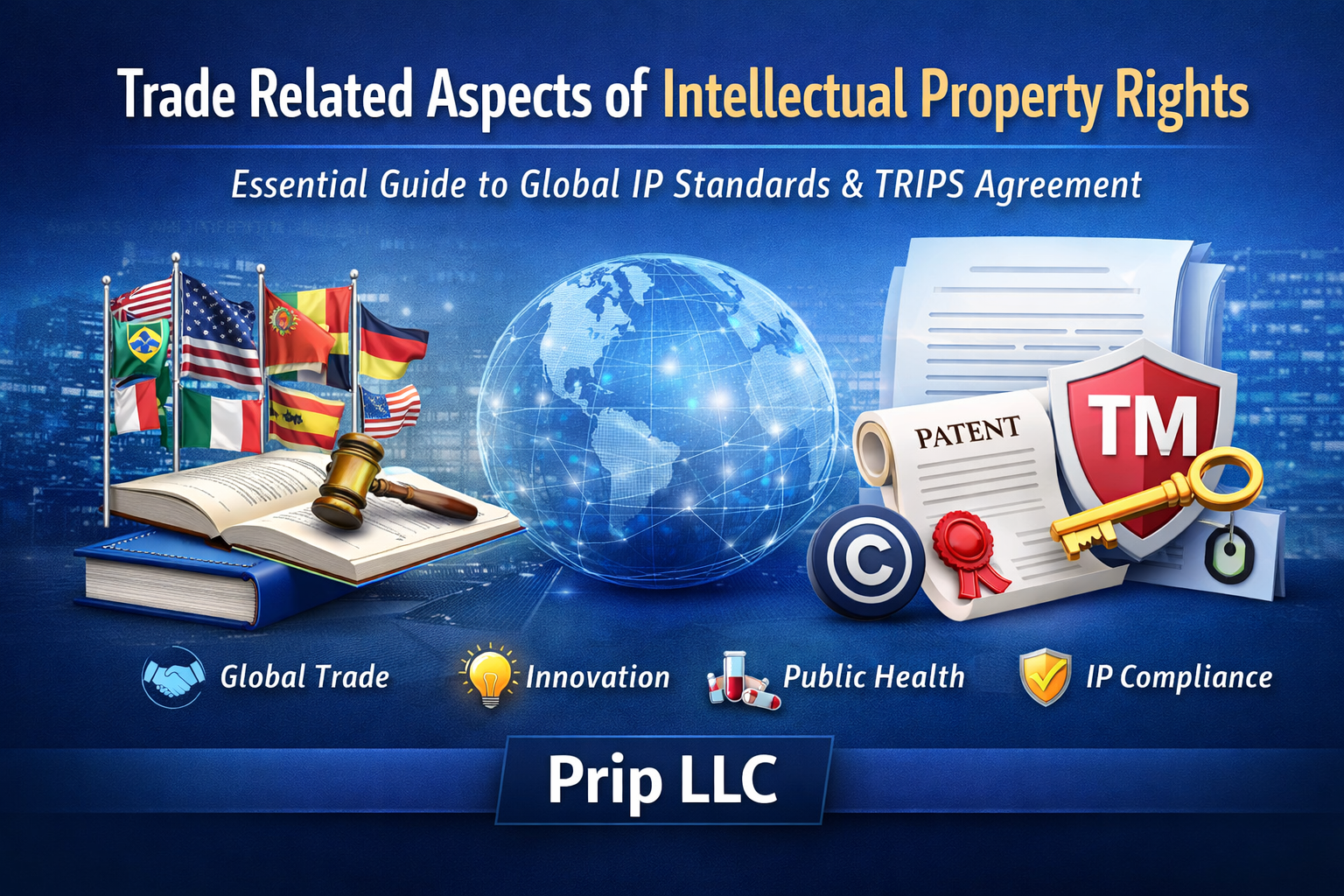
The trade-related aspects of intellectual property rights (commonly known as TRIPS) form the backbone of global intellectual property protection in the modern economy. At Prip LLC, we recognize that understanding TRIPS is essential for businesses, legal professionals, students, and innovators aiming to operate in an increasingly interconnected global marketplace.
This detailed guide provides in-depth trade-related aspects of intellectual property rights notes, offering a complete explanation of its structure, principles, objectives, advantages, challenges, and real-world applications. Whether you are preparing for exams, building a business, or navigating international trade laws, this content is designed to provide unmatched clarity and depth.
What Are Trade Related Aspects of Intellectual Property Rights (TRIPS)?
Definition of TRIPS
The trade related aspects of intellectual property rights refer to an international legal agreement that sets minimum standards for intellectual property regulation among member countries. It is administered by the World Trade Organization (WTO) and establishes uniform guidelines for protecting intellectual property globally.
Key Features of TRIPS
-
Sets minimum standards for IP protection
-
Applies to all WTO member countries
-
Covers multiple types of intellectual property
-
Enforces dispute resolution mechanisms
-
Integrates IP laws with international trade
At Prip LLC, we emphasize that TRIPS is not just a legal framework—it is a strategic tool for global business expansion.
Historical Background of TRIPS Agreement
Evolution of Intellectual Property Protection
Before TRIPS, intellectual property laws varied significantly across countries. This inconsistency created barriers to international trade and led to widespread infringement issues.
Key Milestones
-
Paris Convention (1883)
-
Berne Convention (1886)
-
Establishment of WTO in 1995
-
Introduction of TRIPS Agreement
The trade-related aspects of the intellectual property rights agreement was introduced to harmonize global IP standards and ensure fair trade practices.
Objectives of Trade-Related Aspects of Intellectual Property Rights
Core Objectives
The TRIPS Agreement aims to:
-
Promote innovation and creativity
-
Ensure fair competition in global trade
-
Provide legal certainty for investors
-
Facilitate technology transfer
-
Balance rights between creators and users
At Prip LLC, we align business strategies with these objectives to maximize intellectual property value.
Principles of TRIPS Agreement
Fundamental Principles
1. National Treatment
Countries must treat foreign nationals the same as their own citizens regarding IP protection.
2. Most-Favored-Nation (MFN)
Any advantage given to one country must be extended to all WTO members.
3. Transparency
Countries must publish their IP laws clearly.
4. Enforcement
Strong legal mechanisms must be in place to protect IP rights.
Scope of Trade Related Aspects of Intellectual Property Rights
The trade-related aspects of intellectual property rights cover a wide range of IP categories:
1. Copyright and Related Rights
Protection for:
-
Literary works
-
Artistic creations
-
Software programs
2. Trademarks
Protection for:
-
Brand names
-
Logos
-
Symbols
3. Geographical Indications
Products associated with specific regions (e.g., tea, wine).
4. Industrial Designs
Visual design protection of products.
5. Patents
Protection for inventions.
6. Layout Designs of Integrated Circuits
Protection for semiconductor designs.
7. Trade Secrets
Confidential business information.
Key Provisions of TRIPS Agreement
Minimum Standards of Protection
TRIPS sets baseline standards that all WTO members must follow.
Examples
-
Patent protection for at least 20 years
-
Copyright protection for life + 50 years minimum
-
Trademark protection is renewable indefinitely
Enforcement Mechanisms
TRIPS requires countries to implement:
-
Civil and administrative procedures
-
Criminal penalties for infringement
-
Border measures to prevent counterfeit goods
Dispute Settlement
Disputes under TRIPS are handled through the WTO dispute settlement system, ensuring fair resolution.
Importance of Trade-Related Aspects of Intellectual Property Rights
Global Significance
The trade-related aspects of intellectual property rights play a vital role in:
1. International Trade
Ensures smooth cross-border exchange of goods and services.
2. Innovation Protection
Encourages research and development.
3. Economic Growth
Boosts global and national economies.
4. Investment Security
Attracts foreign investment by ensuring IP protection.
At Prip LLC, we help businesses leverage TRIPS compliance for international success.
Advantages of Trade-Related Aspects of Intellectual Property Rights
Key Benefits
-
Uniform global IP standards
-
Strong protection for creators
-
Encouragement of innovation
-
Increased foreign direct investment
-
Enhanced market confidence
Disadvantages of Trade-Related Aspects of Intellectual Property Rights
Key Limitations
-
High compliance costs
-
Reduced access to essential medicines in developing countries
-
Legal complexities
-
Potential monopolies
-
Enforcement challenges
Pros & Cons Table of TRIPS Agreement
| Pros | Cons |
|---|---|
| Standardized global IP laws | Expensive implementation |
| Encourages innovation | Limits access to affordable medicines |
| Boosts international trade | Complex legal framework |
| Protects creators globally | Favors developed countries |
| Attracts foreign investment | Enforcement difficulties |
Impact of TRIPS on Developing Countries
Challenges Faced
-
High cost of compliance
-
Limited technological capacity
-
Dependence on developed nations
Opportunities Created
-
Access to global markets
-
Technology transfer
-
Legal protection for local innovations
At Prip LLC, we guide businesses in developing regions to navigate TRIPS effectively.
TRIPS and Public Health
Balancing IP and Health Needs
TRIPS allows flexibility for public health concerns through:
-
Compulsory licensing
-
Parallel imports
These provisions ensure access to essential medicines during emergencies.
TRIPS and Digital Economy
Modern Relevance
The digital age has transformed the application of trade related aspects of intellectual property rights.
Key Issues
-
Digital piracy
-
Software copyright
-
Online trademark misuse
At Prip LLC, digital IP protection is a core service area.
TRIPS Compliance Strategies for Businesses
Best Practices
1. Conduct IP Audits
Identify all intellectual assets.
2. Register IP Globally
Ensure protection in multiple jurisdictions.
3. Monitor Infringement
Use tracking tools and legal support.
4. Enforce Rights
Take timely legal action.
Role of Prip LLC in Intellectual Property Protection
At Prip LLC, we provide comprehensive support for:
-
IP registration
-
TRIPS compliance
-
Legal consultation
-
Business strategy integration
Our expertise ensures businesses can maximize their intellectual property value globally.
Future of Trade Related Aspects of Intellectual Property Rights
Emerging Trends
-
AI-generated content ownership
-
Blockchain-based IP protection
-
Global IP harmonization
-
Increased focus on digital rights
Frequently Asked Questions (FAQs)
1. What are trade related aspects of intellectual property rights?
They are international rules that set minimum standards for IP protection across WTO member countries.
2. Why is TRIPS important?
It ensures uniform IP protection and facilitates global trade.
3. Who enforces TRIPS?
The World Trade Organization (WTO).
4. What types of IP does TRIPS cover?
Patents, copyrights, trademarks, industrial designs, and more.
5. How long does patent protection last under TRIPS?
At least 20 years.
6. What is compulsory licensing?
A provision allowing governments to permit use of a patent without the owner’s consent under certain conditions.
7. How does TRIPS affect developing countries?
It creates both challenges and opportunities in terms of compliance and market access.
8. What is the MFN principle?
It ensures equal treatment among WTO members.
9. How does TRIPS impact businesses?
It provides global protection and encourages innovation.
10. How can companies comply with TRIPS?
By registering IP, monitoring usage, and enforcing rights legally.
