
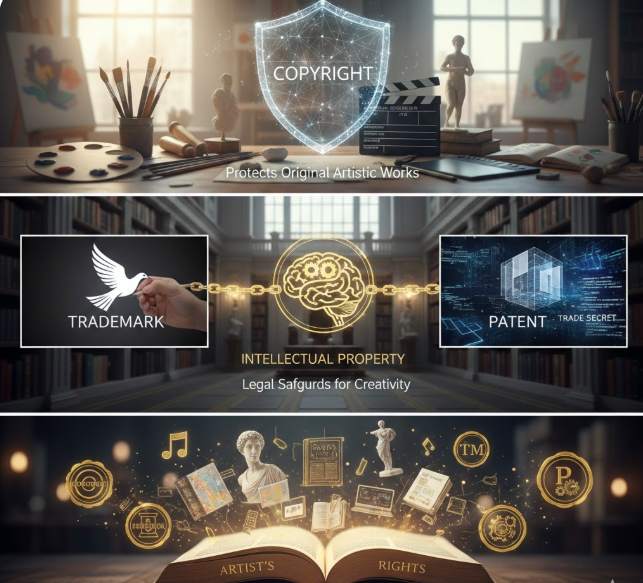
The intellectual property created by artists is protected through a structured system of legal rights designed to recognize ownership, prevent unauthorized use, and enable creators to control how their work is used.
At its foundation, what protects the intellectual property created by artists is not a single law or mechanism. It is a combination of legal protections, contractual tools, enforcement strategies, and practical documentation practices.
These protections exist to ensure that:
-
Artists retain ownership of their original works
-
Unauthorized copying, distribution, or modification can be challenged
-
Creative work can be licensed, sold, or monetized
-
Moral and economic rights are preserved
Why Intellectual Property Protection Matters for Artists
Creative work has value. Without protection, that value can be taken, diluted, or exploited without compensation.
Artists face risks such as:
-
Unauthorized reproduction
-
Commercial misuse
-
Plagiarism
-
Digital theft
-
Loss of attribution
Understanding what protects the intellectual property created by artists is essential for long-term sustainability, not just legal compliance.
Copyright as the Primary Protection for Artists
Copyright is the most fundamental legal protection for artistic works.
What Copyright Protects
Copyright protects original works of authorship, including:
-
Visual art
-
Photography
-
Music
-
Film
-
Literature
-
Digital art
-
Illustrations
-
Sculptures
Once a work is created and fixed in a tangible form, copyright protection typically arises automatically.
At Prip LLC, artists are advised to treat copyright as the backbone of their intellectual property strategy.
Ownership and Originality
For copyright protection to apply:
-
The work must be original
-
The artist must be the creator
-
The work must be fixed in a tangible medium
Ideas alone are not protected. Expression is.
This distinction is central to understanding what protects the intellectual property created by artists.
Economic Rights Under Copyright
Copyright grants artists exclusive rights to:
-
Reproduce the work
-
Distribute copies
-
Display the work publicly
-
Create derivative works
-
License usage
These rights allow artists to control commercial exploitation.
Moral Rights of Artists
In many jurisdictions, artists also hold moral rights, including:
-
Right of attribution
-
Right to integrity of the work
These protect an artist’s reputation and connection to their work.
Registration vs Automatic Protection
While copyright often exists automatically, registration strengthens protection by:
-
Creating public record
-
Enabling statutory damages
-
Simplifying enforcement
From a strategic perspective, Prip LLC often recommends registration for commercially valuable works.
Trademarks and Artistic Identity
Another answer to what protects the intellectual property created by artists lies in trademark law.
What Trademarks Protect
-
Artist names
-
Brand names
-
Logos
-
Symbols
-
Distinctive identifiers
While copyright protects the artwork, trademarks protect the identity associated with it.
Why Artists Use Trademarks
Trademarks prevent:
-
Brand impersonation
-
Consumer confusion
-
Unauthorized merchandising
For artists who sell work, perform publicly, or license their identity, trademarks are essential.
Design Rights and Industrial Designs
For artists working in applied art, fashion, or product design, design protection may apply.
Design rights protect:
-
Visual appearance
-
Shape
-
Pattern
-
Ornamentation
These rights are particularly relevant in commercial product contexts.
Patents and Artistic Innovation
Although less common, patents can protect certain artist-created inventions.
Examples include:
-
New artistic tools
-
Novel production methods
-
Functional design innovations
At Prip LLC, patents are considered when creativity intersects with technical innovation.
Trade Secrets and Creative Processes
Some artistic value lies in methods rather than outputs.
Trade secrets can protect:
-
Creative workflows
-
Production techniques
-
Proprietary formulas
Protection relies on confidentiality, not registration.
Contracts as a Layer of Protection
Contracts are one of the most powerful answers to what protects the intellectual property created by artists.
Contracts define:
-
Ownership
-
Licensing terms
-
Usage scope
-
Duration
-
Payment
Without clear contracts, artists may lose rights unintentionally.
Licensing Agreements
Licensing allows artists to:
-
Retain ownership
-
Grant specific usage rights
-
Generate recurring income
Clear licensing protects both artist and user.
Work-for-Hire Risks
Artists must be careful with work-for-hire arrangements, which may:
-
Transfer ownership entirely
-
Eliminate future control
Understanding this concept is critical to protecting artistic IP.
Digital Rights and Online Protection
Digital platforms introduce new risks.
Protection strategies include:
-
Copyright notices
-
Digital watermarks
-
Platform takedown procedures
-
Metadata embedding
These tools support enforcement in online environments.
Enforcement: Protecting Rights in Practice
Protection without enforcement is meaningless.
Enforcement options include:
-
Cease-and-desist notices
-
Platform takedowns
-
Negotiated settlements
-
Litigation
At Prip LLC, enforcement strategy is aligned with business objectives, not emotion.
International Protection Challenges
Art often crosses borders.
International protection depends on:
-
Treaties
-
Local laws
-
Registration requirements
Artists operating globally need coordinated IP strategies.
Collective Management Organizations
Some artists rely on collective organizations to manage rights, especially in:
-
Music
-
Performance
-
Broadcasting
These organizations license usage and distribute royalties.
Common Misconceptions About Artistic IP Protection
-
“Posting online removes ownership”
-
“Ideas are protected”
-
“Credit equals permission”
Understanding what protects the intellectual property created by artists means correcting these myths.
Documentation and Evidence
Strong protection relies on proof.
Artists should maintain:
-
Creation dates
-
Drafts and versions
-
Contracts
-
Registration certificates
Documentation simplifies enforcement.
IP Protection in Collaborative Work
Collaboration introduces complexity.
Key considerations:
-
Joint ownership
-
Contribution clarity
-
Licensing authority
Without agreement, disputes are common.
Artificial Intelligence and Artistic IP
AI introduces new questions:
-
Authorship
-
Training data
-
Derivative works
Legal frameworks are evolving, making strategic guidance essential.
Pros & Cons of Intellectual Property Protection for Artists
| Pros | Cons |
|---|---|
| Legal ownership recognition | Registration costs |
| Revenue control | Enforcement effort |
| Brand protection | Legal complexity |
| Licensing opportunities | Jurisdictional limits |
| Deterrence against misuse | Time investment |
Why Strategic IP Management Matters
Protection alone is not enough.
Strategic IP management:
-
Aligns rights with goals
-
Supports monetization
-
Reduces disputes
This is why Prip LLC treats intellectual property as a core business asset.
How Artists Lose IP Rights Unknowingly
Common mistakes include:
-
Signing unclear contracts
-
Posting without safeguards
-
Ignoring registration
-
Misunderstanding ownership
Education is prevention.
The Role of Legal Advisors
Professional guidance helps artists:
-
Choose correct protection
-
Draft enforceable contracts
-
Avoid costly errors
At Prip LLC, artist-focused IP strategy is built around clarity and long-term value.
IP Protection for Emerging vs Established Artists
Needs differ by stage.
Emerging artists:
-
Focus on foundational protection
Established artists:
-
Emphasize enforcement and licensing
Protection evolves with career growth.
Intellectual Property as a Long-Term Asset
Protected IP:
-
Increases valuation
-
Attracts investors
-
Enables licensing deals
Art becomes scalable.
Digital Marketplaces and IP Control
Selling online requires:
-
Platform compliance
-
Rights monitoring
-
Fast takedown response
Proactive systems protect revenue.
What Protects the Intellectual Property Created by Artists in Practice
The real answer is layered protection:
-
Copyright
-
Trademarks
-
Contracts
-
Enforcement
-
Strategy
No single tool is enough alone.
Integrating IP Protection Into Creative Workflow
Protection should not slow creativity.
Best practices include:
-
Early documentation
-
Standard contracts
-
Periodic review
This integrates protection naturally.
Artists as Rights Holders, Not Just Creators
Ownership empowers:
-
Negotiation
-
Monetization
-
Control
Understanding what protects the intellectual property created by artists shifts mindset from creator to rights holder.
Using Patents Strategically in Creative Industries
Some artistic innovations qualify for patents, especially where function meets creativity.
To explore this area further, structured guidance is often needed.
Long-Term Impact of Proper IP Protection
Strong IP protection:
-
Preserves legacy
-
Enables succession
-
Protects reputation
It extends beyond the artist’s lifetime.
Why Artists Trust Prip LLC
Artists work with Prip LLC because:
-
IP strategies are practical
-
Legal complexity is translated clearly
-
Creativity and commerce are balanced
-
Protection aligns with growth
Future-Proofing Artistic Intellectual Property
As technology evolves, so must protection.
Forward-looking strategies include:
-
Monitoring digital use
-
Updating contracts
-
Adapting to legal changes
This ensures longevity.
What Protects the Intellectual Property Created by Artists Is a System, Not a Shortcut
Protection is not automatic in practice. It requires:
-
Awareness
-
Structure
-
Discipline
-
Strategic thinking
Frequently Asked Questions (FAQ)
-
What protects the intellectual property created by artists?
Intellectual property created by artists is protected through copyright, trademarks, contracts, licensing agreements, and enforcement mechanisms that recognize ownership and control usage. -
Is an artist’s work protected automatically?
Yes. In most countries, copyright protection arises automatically once an original work is created and fixed in a tangible form. -
Do artists need to register their copyright?
Registration is not always required, but it strengthens protection by creating public records and making enforcement easier in legal disputes. -
What types of artistic works are protected by copyright?
Paintings, drawings, photographs, music, films, digital art, sculptures, and written works are all protected if they are original. -
Can an artist lose ownership of their intellectual property?
Yes. Ownership can be transferred unintentionally through contracts such as work-for-hire agreements or poorly drafted licenses. -
How do trademarks protect artists?
Trademarks protect artist names, logos, and brand identities, preventing others from using confusingly similar identifiers in commerce. -
Are ideas protected as intellectual property?
No. Only the expression of an idea is protected, not the idea itself. -
How can artists protect their work online?
Artists can use copyright notices, digital watermarks, platform takedown requests, and clear licensing terms to protect online content. -
What happens if someone copies an artist’s work without permission?
The artist can enforce their rights through cease-and-desist notices, takedown requests, licensing demands, or legal action. -
Why is professional IP guidance important for artists?
Because intellectual property laws are complex, professional guidance helps artists avoid mistakes, protect ownership, and monetize their work effectively over time.
