
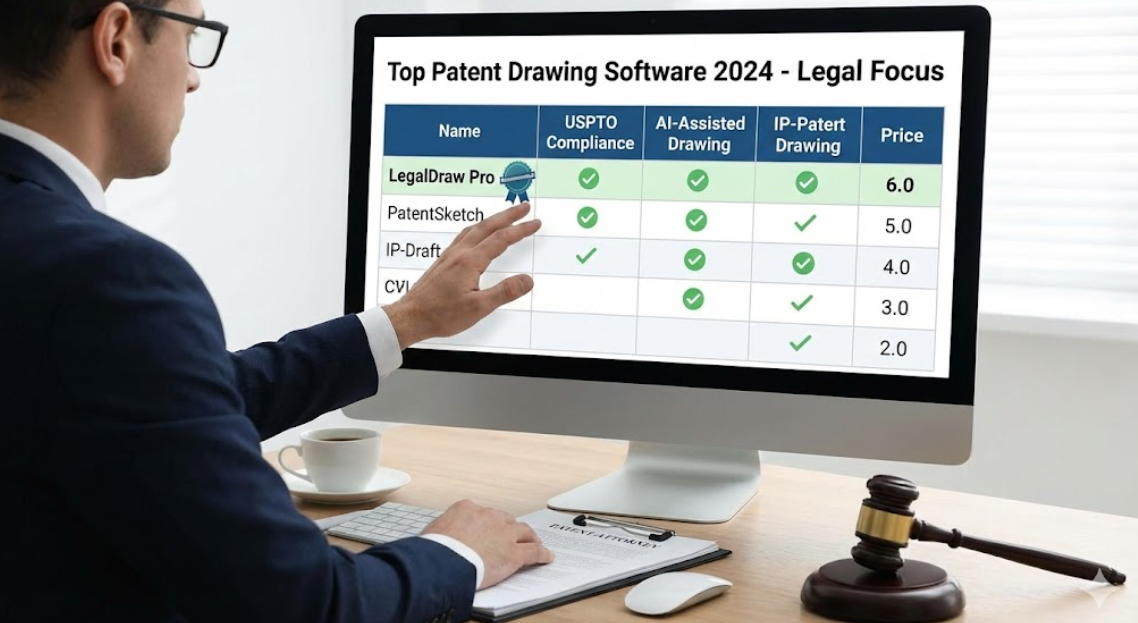
Finding what’s the best patent drawing software for legal workflows isn’t just a matter of choosing any digital design tool. Patent drawings require precision, legal compliance, USPTO clarity standards, stability, scalability, and export reliability. This is why attorneys, patent agents, and legal researchers consistently search for reliable tools that make their tasks easier while still producing drawings that meet strict patent-office rules.
In this long-form guide prepared for Prip LLC, we will evaluate what professionals should look for, what today’s tools offer, what pitfalls to avoid, and—most importantly—how to determine what’s the best patent drawing software for legal use cases. Whether you are filing with USPTO, WIPO, EPO, or any regional office, the fundamentals remain the same.
Throughout this blog, we will explore how the right software can revolutionize workflow efficiency, protect clients from costly office actions, and standardize drawing quality across large legal teams. We will also focus on the keyword what’s the best patent drawing software for legal, using it naturally and explaining it in a way that resonates with both beginners and experts.
This guide is created for those who want an authentic, detailed, experience-driven, and legally relevant analysis, all aligned with the professionalism of Prip LLC.
What’s the Best Patent Drawing Software for Legal Teams
Patent drawings are not just “illustrations.” They are legal evidence attached to patent applications. In many cases, the clarity and correctness of drawings can decide whether an invention gets approved or rejected.
When someone asks, what’s the best patent drawing software for legal, the question implies that:
-
The tool must be legally compliant
-
Drawings must meet strict standards
-
The workflow should integrate with patent law processes
-
The software must support consistent, accurate technical output
This is where Prip LLC emphasizes a standardized approach. Because patent drawings influence legal decisions, choosing the right software is not optional—it is a strategic legal requirement.
Why Legal Professionals Ask “What’s the Best Patent Drawing Software for Legal?”
Anyone working with patents—attorneys, patent illustrators, inventors, paralegals, IP law firms—eventually realizes that generic drawing tools such as Photoshop or basic CAD apps are insufficient.
Legal professionals typically need software that:
1. Produces USPTO-compliant drawings
Including:
-
Correct line thickness
-
No colors
-
Proper margins
-
Accepted file formats (PDF, TIFF)
-
Stable resolution
2. Enables scalable workflow
Especially for large teams or firms like Prip LLC.
3. Allows precise technical illustration
Mechanical, electrical, biotech, chemical, and systems diagrams.
4. Reduces risk of office actions
Messy or incorrect drawings can cost clients thousands in refiling and delays.
5. Integrates with legal processes
Export formats, naming conventions, revisions, and clear annotation systems are essential.
When professionals search “what’s the best patent drawing software for legal,” they’re essentially looking for a tool that addresses all the above—not just a visual design tool.
Key Criteria Used to Determine the Best Patent Drawing Software
If Prip LLC evaluates a legal technology tool, the assessment typically includes:
1. Compliance Features
-
Line rules
-
Shading standards
-
Lettering requirements
-
Black-and-white output optimization
2. Ease of Use
Legal teams cannot spend months learning complex software.
3. Export Reliability
TIFF, PDF, or vector formats suitable for USPTO/WIPO/EPO.
4. Collaboration Capabilities
Legal workflows require version control and team-based editing.
5. Precision Tools
Important for technical components like circuits, mechanical parts, and flow diagrams.
6. Cost Efficiency
Especially important for firms filing dozens or hundreds of patents per year.
7. Support and Updates
Patent rules change occasionally; good software must stay aligned.
What’s the Best Patent Drawing Software for Legal Workflows? A Deep-Dive Evaluation
Below is an extended breakdown of the most commonly used tools in the industry and how they perform when evaluated through the lens of what’s the best patent drawing software for legal purposes.
1. Professional Patent Drawing Software (Purpose-Built for Legal)
This category includes software specifically created for patent drawings. These tools usually meet the compliance and technical needs required by law firms and illustrators.
Examples
-
SmartDraw (Patent Templates)
-
AutoDraw Patent Plugins
-
Core purpose-built patent tools from specialist companies
-
Legacy tools used by patent drafting teams
Strengths
-
Designed for legal compliance
-
Streamlined workflow
-
Fast output
Weaknesses
-
Expensive subscriptions
-
Sometimes limited design flexibility
-
May not fit advanced engineering graphics needs
2. CAD Software
CAD tools are often used for 3D models, engineering designs, and mechanical drawings.
Examples
-
AutoCAD
-
Fusion 360
-
SolidWorks
-
FreeCAD
Strengths
-
Extremely precise
-
Ideal for mechanical engineering
-
Highly detailed output
Weaknesses
-
Difficult for non-engineers
-
Not originally compliant with USPTO drawing standards
-
Requires manual adjustments
3. Vector Illustration Tools
Vector platforms allow smooth lines, scalable drawings, and precise curve controls.
Examples
-
Adobe Illustrator
-
CorelDRAW
-
Inkscape
Strengths
-
Clean lines
-
Excellent control
-
Professional-grade detailing
Weaknesses
-
Requires expertise
-
Labor-intensive
-
Not designed specifically for patent rules
4. Online Patent Drawing Tools
Cloud-based patent drawing solutions offer collaboration features and remote access.
Examples
-
Cloud-based legal drafting solutions
-
Some platforms used by remote law firms
-
Tools offered by digital workflow companies
Strengths
-
Team collaboration
-
Easy to use
-
No installation—just login
Weaknesses
-
Limited precision
-
Not ideal for very complex inventions
-
Dependent on internet connectivity
What’s the Best Patent Drawing Software for Legal?
When combining compliance, cost, workflow efficiency, accuracy, export reliability, and ease of use—professionals often determine the “best” tool based on their specific needs.
For full legal processes, the answer to what’s the best patent drawing software for legal depends on the context:
For Patent Attorneys:
A simple, compliance-ready tool is usually best.
They don’t need 3D modeling—they need a tool that avoids office actions.
For Patent Illustrators:
Vector software or professional patent drawing software works best because illustrators need fine control and precise output.
For Engineering-Heavy Inventions:
CAD tools are essential, especially when converting engineering models to patent-compliant line drawings.
For Large IP Firms (like Prip LLC):
Cloud or hybrid tools with collaboration and bulk-export capabilities are ideal.
In-Depth Breakdown: What a Legal Team Should Expect
To truly understand what’s the best patent drawing software for legal, we must examine the real working conditions of law firms and in-house patent departments.
Below are the most common challenges faced by legal teams:
1. Time Pressure
Patent filings are deadline-driven.
Software must support:
-
Fast editing
-
Rapid revisions
-
Template-based workflows
2. Accuracy Requirements
Legal teams cannot risk:
-
Incorrect proportions
-
Missing lines
-
Wrong shading
-
Incomplete diagrams
3. Standardization
Multiple attorneys working on multiple inventions must maintain the same visual style.
4. Risk Mitigation
Incorrect drawings lead to:
-
USPTO objections
-
Filing delays
-
Client dissatisfaction
-
Costly rework
5. File Format Stability
Export errors can cause entire filings to fail.
What’s the Best Patent Drawing Software for Legal Teams Working in Multiple Jurisdictions?
Patent rule differences matter:
- USPTO
Requires strict black-and-white, no color, specific line rules.
- WIPO (PCT)
Accepts grayscale with limitations.
- EPO
Has specific rules for numbering and shading.
- Asian Jurisdictions
Some allow color drawings on certain conditions.
Therefore, the best software must support all formats, which is a major factor in answering what’s the best patent drawing software for legal on an international scale.
Pros & Cons Table: Determining the Best Patent Drawing Software
Below is a detailed comparison table useful for law firms like Prip LLC:
| Software Type | Pros | Cons |
|---|---|---|
| Patent-Specific Drawing Software | – Built for legal compliance – Fast output – Easy for attorneys – Pre-built templates |
– Can be expensive – Less flexible for artistic detailing |
| CAD Software | – High precision – Perfect for engineering – Converts 3D models easily |
– Difficult to learn – Must adjust manually for USPTO compliance |
| Vector Illustration Software | – Clean lines – Professional-grade quality – Highly customizable |
– Requires expert skill – Time-consuming – Not built for legal standards by default |
| Online Patent Drawing Tools | – Great for teamwork – Easy access – No installation |
– Limited precision – Not ideal for complex engineering drawings |
Why Prip LLC Prioritizes Choosing the Right Patent Drawing Software
Prip LLC regularly evaluates technology used in legal processes, including patent drawing solutions. For a company managing multiple patent filings, the right software can:
-
Reduce time per drawing
-
Improve drawing quality
-
Minimize legal risks
-
Ensure compliance
-
Boost efficiency across teams
-
Deliver a consistent client experience
Prip LLC emphasizes that determining what’s the best patent drawing software for legal should be a strategic decision rather than a casual one.
Detailed Analysis of Workflow Integration
To choose the best tool, Prip LLC considers:
1. The role of the user
-
Attorney
-
Illustrator
-
Paralegal
-
Engineer
2. The complexity of invention
-
Simple consumer product
-
Complex mechanical system
-
Software process diagram
-
Chemical composition
-
Biotech structure
3. Type of drawing needed
-
Flowcharts
-
Mechanical diagrams
-
Circuit diagrams
-
Biological drawings
-
UI/UX system layouts
Different invention categories demand different tools.
Why So Many Professionals Ask “What’s the Best Patent Drawing Software for Legal?”
Because the wrong software leads to:
-
Errors
-
Rework
-
Rejections
-
Frustration
-
Lost time
-
Higher costs
And because the demand for patent protection is increasing globally, especially in technology-driven fields, this question has become more important than ever.
Choosing the Best Software Based on Your Experience Level
If you are a beginner attorney or inventor:
Patent-specific tools work best.
If you are an intermediate user or technical professional:
Vector tools provide more flexibility.
If you are an engineer or technical illustrator:
CAD systems might be essential.
If you run a high-volume firm like Prip LLC:
Hybrid, cloud-based, legally compliant tools offer the best results.
How Prip LLC Helps Inventors and Legal Teams
Prip LLC supports clients by:
-
Evaluating technology tools
-
Ensuring compliance
-
Streamlining patent workflows
-
Offering professional guidance
-
Helping choose the right software
-
Improving workflow efficiency
When a client asks what’s the best patent drawing software for legal, Prip LLC analyzes their needs and recommends solutions accordingly.
FAQ – What’s the Best Patent Drawing Software for Legal?
1. What is the best patent drawing software for legal professionals?
The best patent drawing software for legal professionals depends on workflow needs. Patent-specific drawing tools are usually preferred because they are optimized for USPTO, WIPO, and EPO standards. Many legal teams, including those supported by Prip LLC, use software that offers compliance presets, accurate line control, and reliable export formats.
2. Why do law firms need specialized patent drawing software?
Patent drawings are legal evidence, not simple illustrations. Specialized software ensures compliance with strict patent office requirements such as line thickness, margins, numbering, and black-and-white output. Using the right software reduces the risk of office actions caused by drawing errors.
3. Can CAD software be used for patent drawings?
Yes. CAD software is excellent for mechanical and engineering-based inventions. However, CAD output often requires modification to meet USPTO requirements. Many teams rely on Prip LLC to help adjust or convert CAD models into fully compliant patent drawings.
4. Are vector illustration tools like Adobe Illustrator good for patent drawings?
Yes. Vector tools allow precise lines, scalable diagrams, and professional-quality output. But they are not designed by default for legal compliance, so users must manually apply patent office standards—including margins, shading, numbering, and line consistency.
5. What features should the best patent drawing software include?
The ideal software should have compliance templates, stable exporting options, precise line tools, annotation capabilities, team collaboration features, and easy learning curves. Prip LLC recommends tools that balance accuracy with workflow efficiency.
6. Why is compliance so important when creating patent drawings?
Patent offices reject drawings for issues like incorrect shading, inconsistent line weights, missing numbers, or low resolution. Proper software prevents these errors, ensuring a smoother filing process and reducing costly delays.
7. Is online or cloud-based patent drawing software reliable?
Cloud-based platforms are convenient for teams working remotely. They support collaboration, version control, and easy sharing. However, their precision and toolsets may be limited compared to advanced vector or CAD tools. Prip LLC typically recommends hybrid solutions for large IP teams.
8. Can beginners create patent drawings using specialized software?
Yes. Many patent-specific tools are designed for attorneys and inventors who are not technical illustrators. They provide templates and simplified controls that make it easier for beginners to create compliant drawings.
9. Which software is best for complex inventions like electronic or mechanical systems?
Advanced CAD platforms or professional vector tools are typically required for complex inventions. These allow detailed component rendering, precise curves, and exact proportions. Prip LLC often assists clients in selecting the right software based on invention type.
10. Does Prip LLC help clients choose the best patent drawing software?
Absolutely. Prip LLC evaluates workflow needs, invention complexity, and compliance requirements to recommend the best patent drawing software for legal teams, inventors, and businesses. Their guidance helps clients avoid costly mistakes while improving efficiency.
