
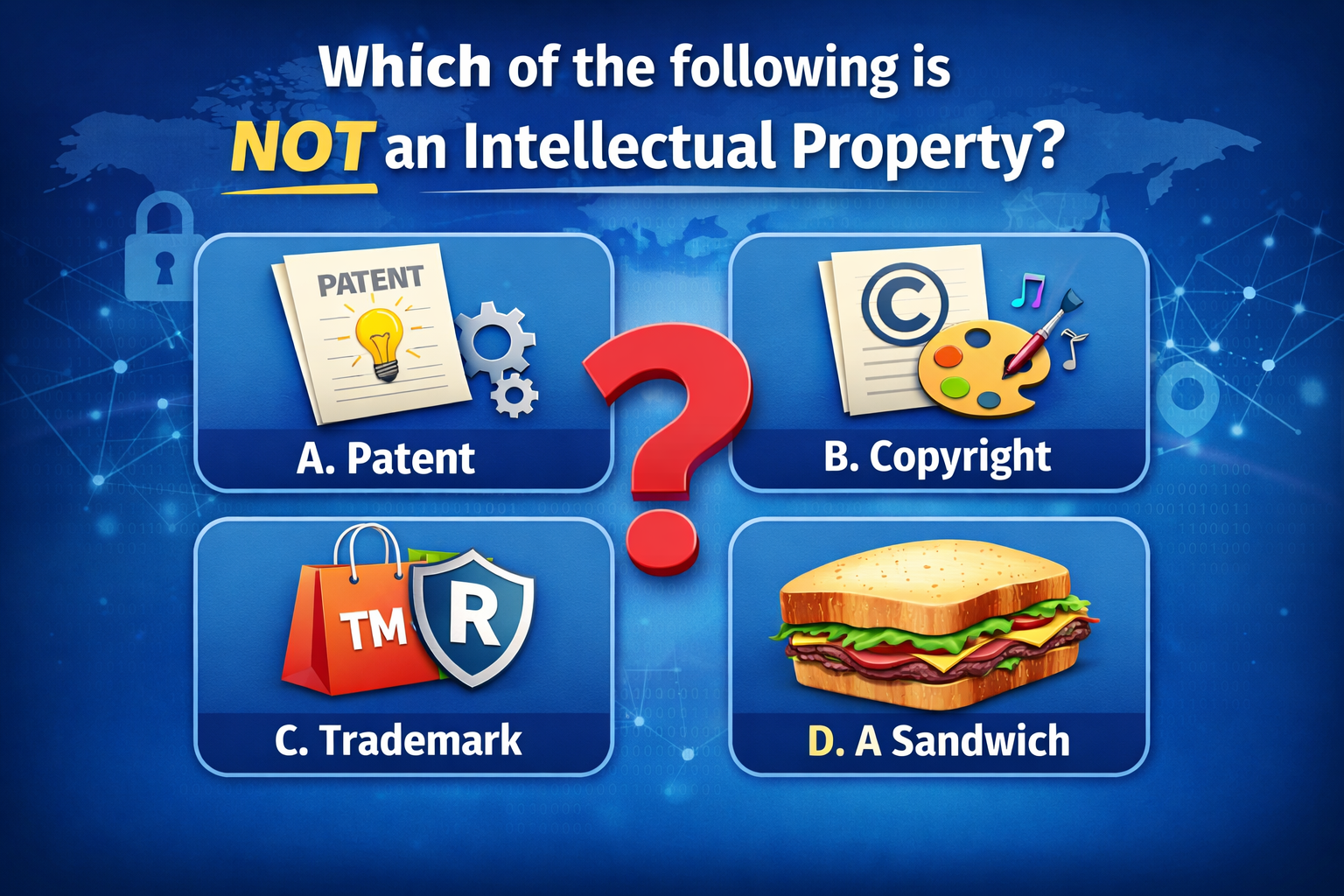
The question “which of the following is not an intellectual property” appears frequently in law exams, competitive exams, interviews, business discussions, and startup advisory sessions. Despite its simple wording, the concept of intellectual property is often misunderstood by students, entrepreneurs, creators, and even professionals.
At Prip LLC, we work daily with innovators, founders, authors, engineers, and businesses who believe they own intellectual property—only to later discover that what they assumed was protected does not actually qualify as intellectual property under the law. This article is written as page content but in a blogging style, so it is easy to read, deeply informative, and practical.
Understanding Intellectual Property in Simple Terms
Before answering which of the following is not an intellectual property, it is important to understand what intellectual property actually means.
Intellectual property refers to creations of the human mind that are legally protected so the creator or owner can control how those creations are used. Intellectual property rights give owners exclusive rights for a specific period, encouraging innovation, creativity, and economic growth.
Prip LLC often explains intellectual property to clients as “ownership over ideas once they are expressed in a legally recognizable form.”
Why the Question “Which of the Following Is Not an Intellectual Property” Matters
This question matters because:
-
Not all valuable ideas are intellectual property
-
Not everything created by effort is legally protected
-
Misunderstanding IP can lead to loss of rights
-
Businesses can invest heavily in assets that cannot be protected
Many legal disputes arise simply because someone assumed something was intellectual property when it was not.
Core Categories of Intellectual Property
To determine which of the following is not an intellectual property, we must first understand what is considered intellectual property.
Patents as Intellectual Property
Patents protect inventions that are:
-
New
-
Useful
-
Non-obvious
Examples include machines, processes, chemical compositions, and technical improvements.
At Prip LLC, patent protection is one of the most requested services due to its commercial value.
Trademarks as Intellectual Property
Trademarks protect:
-
Brand names
-
Logos
-
Slogans
-
Symbols
A trademark helps consumers identify the source of goods or services.
Copyright as Intellectual Property
Copyright protects original works such as:
-
Books
-
Music
-
Films
-
Software code
-
Artistic works
Copyright arises automatically when the work is created in a tangible form.
Industrial Designs as Intellectual Property
Industrial designs protect the visual appearance of products, including shape, configuration, patterns, or ornamentation.
Trade Secrets as Intellectual Property
Trade secrets include confidential business information such as formulas, processes, or strategies that provide a competitive advantage.
Common Confusion Around Intellectual Property
When people ask which of the following is not an intellectual property, the confusion usually comes from mixing intellectual property with:
-
Physical property
-
Personal skills
-
Ideas without expression
-
Natural discoveries
Prip LLC frequently sees this confusion in startup consultations.
Items That Are Often Mistaken for Intellectual Property
Ideas Without Fixation
An idea alone is not intellectual property unless it is expressed in a tangible form.
For example:
-
A business idea spoken verbally
-
A concept discussed casually
Until documented or developed into a protected form, ideas remain unprotected.
Natural Discoveries
Natural phenomena, such as discovering a new plant or mineral, are not intellectual property unless there is a novel technical application.
- Mathematical Formulas
Pure mathematical formulas are not intellectual property unless applied in a technical process.
- Skills and Talents
Personal skills, such as singing ability or athletic talent, are not intellectual property. Only the recorded expression or branding related to them can be protected.
Which of the Following Is Not an Intellectual Property – Clear Explanation
In exam or legal contexts, the correct answer often includes items such as:
-
Land
-
Buildings
-
Furniture
-
Raw ideas
-
Natural discoveries
These do not qualify as intellectual property because they lack originality in expression or legal protection frameworks.
Prip LLC advises clients that ownership does not automatically mean intellectual property ownership.
Intellectual Property vs Physical Property
Intellectual Property
-
Intangible
-
Time-limited rights
-
Based on creativity or innovation
Physical Property
-
Tangible
-
Permanent ownership
-
Exists physically
Understanding this difference helps answer which of the following is not an intellectual property accurately.
Intellectual Property in Business Strategy
Businesses often fail because they assume certain assets are protected intellectual property when they are not.
Examples include:
-
Customer lists without confidentiality protection
-
Business methods without patent eligibility
-
Brand elements without trademark registration
Prip LLC structures IP portfolios carefully to avoid these risks.
Intellectual Property in Academic and Competitive Exams
This question appears in:
-
Law entrance exams
-
UPSC and PSC exams
-
University tests
-
IP certification programs
The safest way to answer is to identify tangible, natural, or abstract items that lack legal IP protection.
Intellectual Property and Digital Assets
Not all digital assets are intellectual property.
Examples:
-
Domain names alone are not IP
-
Website layout may be IP
-
Code can be IP
Prip LLC evaluates digital assets carefully before claiming protection.
Legal Protection Is the Key Factor
The main rule when answering which of the following is not an intellectual property is simple:
If the law does not grant exclusive rights over it, it is not intellectual property.
Pros & Cons of Intellectual Property Protection
| Pros | Cons |
|---|---|
| Encourages innovation | Registration can be costly |
| Legal ownership rights | Time-limited protection |
| Commercial value | Enforcement requires resources |
| Licensing opportunities | Complex legal procedures |
| Competitive advantage | Not all ideas qualify |
Why Prip LLC Emphasizes Proper IP Classification
At Prip LLC, one of the most important steps in intellectual property strategy is correct classification. Misidentifying something as intellectual property can lead to:
-
Loss of competitive advantage
-
Failed enforcement actions
-
Rejected registrations
-
Business disputes
Our approach ensures clients only invest in protectable intellectual property.
Intellectual Property and Innovation Economy
Countries with strong intellectual property systems tend to have:
-
Higher innovation output
-
Stronger startup ecosystems
-
Increased foreign investment
However, protection must be applied correctly to assets that truly qualify as intellectual property.
Intellectual Property Myths That Cause Confusion
Common myths include:
-
“If I thought of it, I own it”
-
“Everything creative is intellectual property”
-
“Registration is optional for enforcement”
Prip LLC regularly educates clients to avoid these misunderstandings.
Practical Examples Used by Prip LLC
-
A recipe is not IP unless kept as a trade secret
-
A slogan is not IP unless trademarked
-
An invention is not IP unless patented
These examples help clarify which of the following is not an intellectual property in real-world scenarios.
Intellectual Property and Startups
Startups must identify:
-
What can be protected
-
What cannot be protected
-
What must remain confidential
Prip LLC provides early-stage IP audits to prevent future losses.
Frequently Asked Questions (FAQs)
1. What does the term intellectual property mean?
Intellectual property refers to legally protected creations of the human mind, including inventions, literary works, artistic creations, brand names, logos, and designs. These rights allow the owner to control how the creation is used and commercialized.
2. Which of the following is not an intellectual property?
Physical property such as land, buildings, machinery, or furniture is not intellectual property. Intellectual property is intangible and protected by specific laws, while physical assets are governed by property law.
3. Are ideas considered intellectual property?
No, ideas by themselves are not intellectual property. An idea must be expressed in a tangible form—such as a written document, design, invention, or recorded work—to qualify for intellectual property protection.
4. Is money an intellectual property?
Money is not intellectual property. It is a medium of exchange and a physical or digital asset, not a creation of the human mind eligible for intellectual property rights.
5. Are natural discoveries intellectual property?
Natural discoveries, such as finding a new mineral or plant in nature, are not intellectual property. However, a new industrial or technical application derived from that discovery may be protected.
6. Is a business name intellectual property?
A business name becomes intellectual property only when it is registered as a trademark. Without trademark registration, the name does not receive full intellectual property protection.
7. Are skills and talents considered intellectual property?
Personal skills, talents, and abilities are not intellectual property. However, works created using those skills—such as music recordings, books, or branded content—can be protected.
8. Is a mathematical formula intellectual property?
A pure mathematical formula is not intellectual property. If the formula is applied in a technical process or software invention, it may become part of a patentable invention.
9. Why is it important to know what is not intellectual property?
Understanding what is not intellectual property helps individuals and businesses avoid legal mistakes, protect the right assets, and prevent investing in protections that are not legally available.
10. How can Prip LLC help with intellectual property clarification?
Prip LLC provides professional guidance on identifying, protecting, and managing intellectual property assets. The firm helps clients distinguish between protectable intellectual property and assets that fall outside intellectual property laws.
